Episode Transcript
[00:00:00] Speaker A: Hi, everyone. Welcome to Another episode of DevtoDev, the podcast about everyday video game developers and why they do what they do every day. I'm Alex Salmon, ready for another conversation, this time with a former colleague and friend. Got it right this time. I've messed it up on the last two.
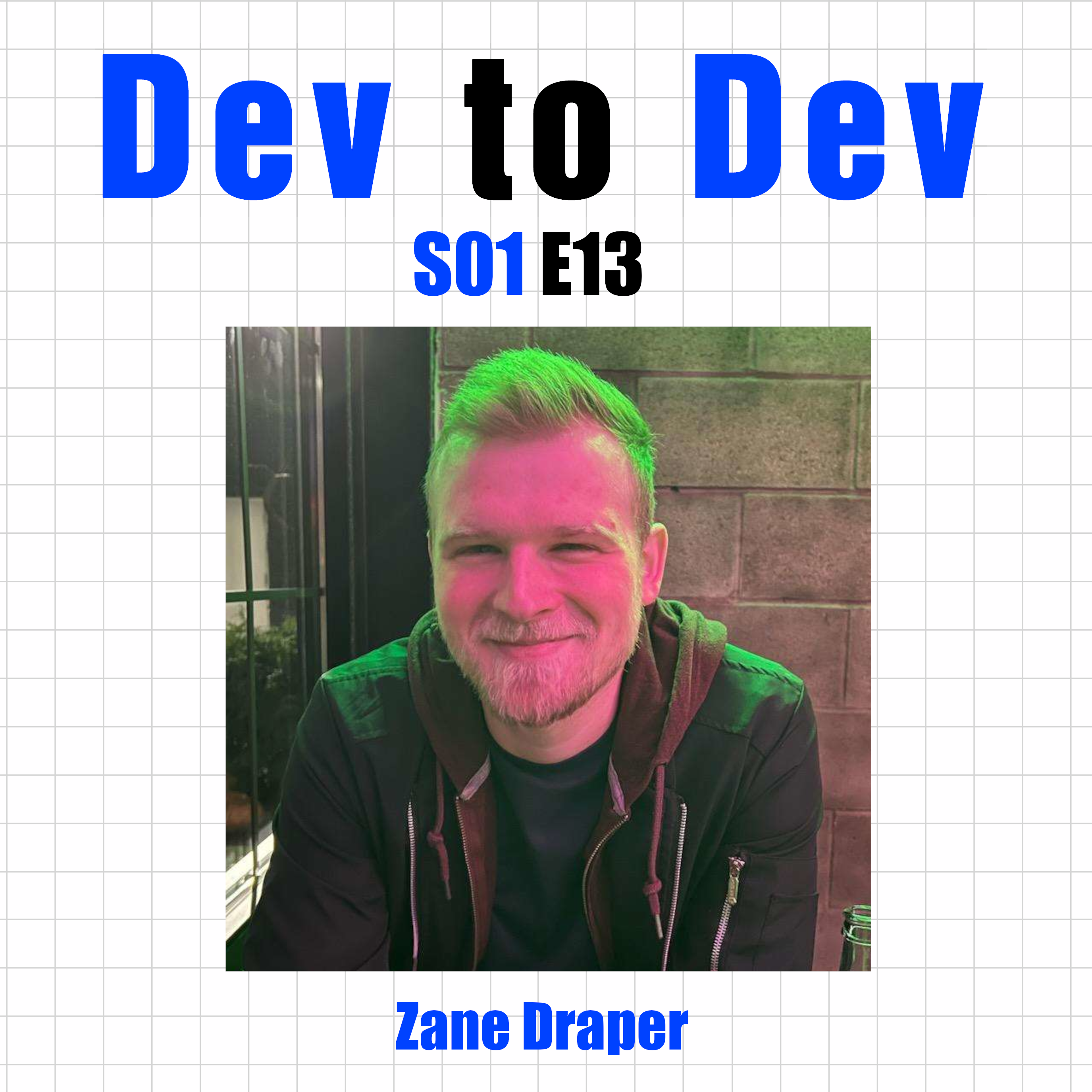
Zane, would you like to introduce yourself?
[00:00:16] Speaker B: Yeah, absolutely. Hi, everybody. I'm Zane. I'm a senior technical designer. I've been in the industry about 10 years or so and I've done a range of stuff, everything from VR to AR to museum installations and beyond. So pretty excited to be here.
[00:00:31] Speaker A: Yes, I'm really excited to dig into your history, Zane. You've got some fascinating bits and bobs to talk about and what your experience was.
So thank you for taking the time. I always like to start this conversation with my favorite question. What first inspired you about video games?
[00:00:46] Speaker B: Oh, I've been playing games since I was, you know, a kid. I think the first thing that I played that really kind of made me feel like this is something I was really interested in.
It was on the original Game Boy I little backstory. It was the Game Boy color. I traded 10 toy cars in kindergarten for the original Game Boy with Pokemon Yellow. And Pokemon Yellow is kind of what. What hooked me from there on. And I've just been playing ever since. And I don't think I really knew it would be a career as so much as I knew I was obsessed with them. But eventually it did turn into one. So pretty, pretty early transition for me.
[00:01:27] Speaker A: Love that. And I'm going to say heck of an exchange rate. 10 toy cards for Gameboy Pokemon Yellow.
[00:01:33] Speaker B: His mom was not happy, but I refused to give it back.
[00:01:37] Speaker A: Well done, sir. Well done.
Okay, so Game Boy, Pokemon, kind of the thing that kickstarted you. Where, where did you grow up? Where did that, where was this kind of happening?
[00:01:47] Speaker B: Yeah, Bath, New York. So just a really, really small town. Not a lot of people there and not. Not a tech hub. No game studios or anything.
Yeah, just small town, small town America, I guess.
[00:02:01] Speaker A: Right, right. And so, you know, growing up in a small town, fell in love with video games. What kind of age did you say that was? Kindergarten.
[00:02:08] Speaker B: That was kindergarten when I, when I first started playing the color there.
[00:02:11] Speaker A: Right. Okay. So, so nice and young, trying to, you know, video games got hooked to you really early. That's good.
And so do you have any siblings? Did you grow up with any other, any other gamers in the house?
[00:02:22] Speaker B: Yeah, I've got three siblings, all gamers. You know, my, my older brother Eric Used snes and he'd invite us over to play once in a while with him and his friends. So that was, that was really big. And then my little brothers have been playing as well their entire lives.
[00:02:39] Speaker A: Okay, so big gaming family then all gamers. Okay.
And so sort of Game Boy snes, that kind of era was what piqued your interest? Was there anything particular about those games or was it just games in general? Just the interactivity games.
[00:02:52] Speaker B: Games in general? I think I definitely, I had Tetris and everything as well. I may. I. I think it's always the challenge of them that kind of hooks me. Narrative is always a lot of fun and I've always enjoyed them, but it's kind of those minute by minute challenges that kind of draw you in or draw me in personally and kind of drive that addiction. Like, kind of like the Balatro formula there where you're, you're kind of playing round by round. And that's kind of what hooks me more than any long term effect. Though I do love a narrative game.
[00:03:21] Speaker A: Right, interesting. So kind of the immediate challenge, trying to beat yourself, beat your score, trying to just get better and better is what drives me.
[00:03:27] Speaker B: Yeah, yeah. Almost like a gambling loop without any actual gambling, but kind of that, that immediate payoff and you're like, oh, I think I could do better than that. I think I could beat that score. I gotta try again and then I'll just lose hours into it, you know.
[00:03:40] Speaker A: Right. So that, that. Has that always been the draw? Does that continue to be the draw now?
[00:03:45] Speaker B: Yeah, I still love those challenge games. I think I've. In my, in my advancing years, I've transitioned more into what I call a social gamer. The individual games matter less and less to me these days. They still gotta be fun. But I usually find that I'm drawn to whatever I can play with other people. If that's, if that's Couch co op, if that' know Tower Fall just with a couple friends that are sitting on the couch, or if that's the new Battlefield game or something like that. As long as I've got people to play with, I think that's become more of the, the draw for me in these days.
[00:04:14] Speaker A: Got it. Okay, that makes sense.
Okay, so. So early kind of competition challenge games kind of, you know, things that, on those early consoles getting you excited.
Did you, in that early, in those early years, did you ever think that you could make video games? Were you ever drawn to the actual production of video games? Was it just the playing?
[00:04:32] Speaker B: Just the playing. When I was a Kid, it was always one of those things that all of your friends were talking about, oh, I'm gonna make video games when I grow up. And for me, that never really stuck as a possibility. Even when I went to college, I didn't think that was a career path. You know, I had no clue what I was going to college for. But video games was never even on my radar as an option until I think my almost my third year of college. And all of a sudden I was like, that's, oh, people do that. I could do that.
So no, all through my childhood it was mostly just a passion for playing that eventually turned into a career years and years down the road.
[00:05:06] Speaker A: Got it. Yeah. And so you went to Rochester Institute of Technology, correct?
[00:05:11] Speaker B: Yeah, yep, I did. I did a year at community college, a local Corning community college where I, I just transitioned my program three times. I philosophy, mathematics, and then computer programming because I had no clue what I wanted to do. And then after that first year I transitioned to rit.
[00:05:28] Speaker A: Right, okay. And so you were there for programming. So. So programming are kind of drawn you at the engineering side are kind of drawn you in at some point?
[00:05:35] Speaker B: Well, actually when I, when I started at rit, my first three years or two and a half years at RIT were actually for a robotics electrical engineering program. I didn't even know that. It wasn't until I was halfway through my program at RIT that I was like, oh, they have a game design program. And it's, it kind of encapsulates that coding that I love. Because I didn't know I like to program until I got into that robotics program. And we're doing more like chip development and stuff. And then in the third year or second year they had to start to dive into like actual programming languages to design the chips. And I'm like, no, this is my thing. I really, really enjoy this.
And then I realized I didn't really enjoy robotics as much. It was too small scale. And you don't really see the payoff for what you're working on. Very quick. It takes a long time to develop the tech and then you turn around and you. I think for one of my classes as a demo, I made like a little ASCII command lined Monster Hunter game. And I was like, no, this, if I this for a career, that's. That's the way to go.
[00:06:34] Speaker A: Right, that's fascinating. So you didn't really have any programming sort of desires until you stumbled across it on a different course.
And then what was it about engineering that drew you in so quickly.
[00:06:47] Speaker B: Problem solving, I think it's the same thing that draws me into playing games is the same thing that draws me into, you know, any type of tech development or you know, developing video games is pretty much always just problem solving. Whether that's solving a design problem to make something fun or just solving a coding problem or debugging.
Problem solving is kind of my, my, my go to answer for that. It's always whenever I'm doing interviews I'll be like this is the cheesiest answer ever. But I don't the, the property and what I'm working on is important but the bigger thing is it's just got to be, have, have dynamic, dynamic problems to work on.
And that's what drew me to engineering without a doubt.
[00:07:23] Speaker A: Yeah, interesting. So problem solving and also I'm guessing here having the tools to solve them. Right. Because engineering is like a direct, there's a problem, I directly execute the code to solve that problem kind of thing. There's a one to one relationship there.
[00:07:37] Speaker B: Yeah, absolutely. And, and I think in games even more so you see that result immediately. You, you can run and see like did I, did I solve the problem or is it still there? You can, you can, you can see that result instantly. So it was just kind of that natural evolution from, you know, that an engineering focused background to you know, getting into something that is visual and you can see people play and you can solve those problems immediately.
[00:07:59] Speaker A: Right, got it. That makes sense. So you see the challenge, you figure out solution, you solve it, it happens in front of you and then you move on to the next one. That's. Yeah, yeah, that makes a lot of sense. And so you stumble across a game design course whilst doing something else and I'm guessing it's that you were like as a gamer, that was just immediately like that sounds fun, I want to do that.
[00:08:17] Speaker B: It did. I didn't think it was going to happen.
The RIT game dev program was pretty, pretty strict and that was for like new students. So transfer students within the college were also, I think only like three or four made it over that year for like a transfer from another program.
But I didn't think it was going to happen. But I wanted to take that shot. So that semester I learned like three new programming languages. I made a portfolio of like five really, really bad games.
But just to show off that I was willing to learn and kind of jump into all these different things and they loved it and I was able to transfer over and I think I started in my second semester of my third year and I finished a four year program, I think in like two years. So it was, it was quite the rush.
[00:09:00] Speaker A: Yeah. And I guess you must have taken to it like a duck to water then to kind of be able to complete it that quickly. It just clicked with you right away.
[00:09:09] Speaker B: Absolutely. And it was a game design and development program. So a lot of the programming I had already done in the other program was.
And engineering was already like at that level where I needed to be. So it was easy to kind of transfer over there. And then it was picking up all those design skills and that understanding about how to make a game fun that I kind of had to focus on for those years in the program.
[00:09:30] Speaker A: Interesting. Yeah, so it was. So that game design angle was kind of more creative than a straight engineering course. I guess you had that blend of engineering and game design in that course.
[00:09:41] Speaker B: Yeah, yeah, it was both. They really wanted to focus on making sure you had those technical skills. But then there was entire classes on game design and coming up with, you know, game docs and pitches and then coming up with final deliveries for games that were fun and you'd get evaluated on that. But then you had to do all that implementation yourself to prove that you also knew how to use an engine or, or to code or anything like that.
[00:10:03] Speaker A: Wow. Yeah, very technical course. That's. That sounds like fun.
And so from there out of college, how did you transition from. I mean, I guess during college you were doing. There was quite a lot of overlap with co designing some other projects and, and working on. I want to just dig into a little bit the, the associated association of Blind and Visually Impaired project. You worked on the labyrinth. Like how did that come about?
[00:10:29] Speaker B: Yeah, that was a student project, something we were just working on where we, you know, the RIT has a very diverse community. We have a lot of deaf or blind students.
So we wanted to set up a game that could be played by students that were visually impaired. And so that was a lot of just audioscaping, trying to make sure an audio based world was something that could be navigable. So a lot of that was just text based prompts, but also trying to use that kind of. Of three dimensional audio just to make an environment. I think it was a dungeon we were working on. So like cueing audio like oh, there's a trap springing to your right or you hear a monster off to your left in the distance.
So just a lot of that kind of stuff. It was, it was very student led. We had a voice actor that was another student to Kind of narrate the whole thing.
A lot of fun. But it was, it was a very unique project that we worked on.
[00:11:18] Speaker A: Got it. Interesting. And a real convergence there of design and programming then. Yeah, like you're really trying to solve. That's a tricky game design problem to solve to create mechanics for the vi. So really interesting how that must have really pushed your game design and implementation skills.
[00:11:33] Speaker B: Absolutely. And it wasn't done in a game engine or anything. We were doing that all from scratch. So it was kind of like that, that initial bite at very, very diverse problem solving and kind of led into a lot of later projects and things. That kind of mentality of being open to solving the problem outside of a kind of traditional game engine or project sense.
[00:11:54] Speaker A: That's cool.
And so. So from college, how did you sort of transition from there into an industry job?
[00:12:02] Speaker B: Yeah, so I had kind of bounced around between a couple of different jobs when I was in college doing like basic QA for a Candy Crush style game, doing level testing and things like that. Then I did a volunteer project at a studio called Galaxy in Turmoil, which was just kind of a large scale FPS free to play that I worked with, but volunteer, not paid or any.
So I was working actually at the school, working on a VR game for a football team, actually for a VR experience for a pre game setup.
When a friend of mine who was working at a local game studio, one of the only local game studios called Workin man, he was working there and he had come in to visit some friends because he had just graduated the year before.
And he goes, yeah, they're looking for people. And I'm like, I'm looking for people. How about you take my application in? And he goes, okay, I'll see if they're interested. And he takes the application in. And luckily the studio was really, really entwined with rit. Most of the people that they hire, I think it was like 95% of the staff at the time was RIT alumni or even professors who were kind of working with the studio.
So it was a pretty honestly, in the, in the state of the industry, it was a pretty easy interview. Things went really, really well. I walked in, I did one interview with them, it went great. I walked out of there, went to my favorite sushi place across the street and I think I had a call by the time I was driving home that I had got the job. So it was the easiest interview process I've had since college, but landed me in kind of that kind of definitive role. My time at workman I feel like, kind of really shaped how I approach and how I work with problems these days.
[00:13:41] Speaker A: Interesting. Yeah. And I guess you were hired as a programmer. Correct.
[00:13:47] Speaker B: Workman is kind of unique, which is one of the selling points for it for me is that they didn't have programmer or designer roles, they only had a developer role. And that meant that you were doing both.
We were working with clients, all kinds of people, Nickelodeon, Disney, you know, all kinds of different people would come and hire the studio and you got to help design the work, design what the game should be like. But then you had to do all of the implementation yourself.
We worked anywhere from like a three person team to a 15 person team on different projects. So you were doing both, which I think the RAC program really lent itself well to because all of a sudden you're in the fire and you're going, oh, I need to make this and I need to design this and needs to be good because these are clients.
So it paid off really, really quick as soon as I joined with the studio.
[00:14:36] Speaker A: Yeah, I was gonna say that sounds like the professional version of your college college experience.
[00:14:40] Speaker B: Yeah, 100%. And I think, I think because the college was so entwined with the studio that it, it lent itself well, they didn't need to focus on finding two different roles. The people that were graduating from the program did both things. They were, and they were very good at both things. So.
[00:14:54] Speaker A: Right. That makes a lot of sense. So that must have. You say it gave you a really good grounding in development.
A lot of projects. You got to work on a lot of different types of projects, I'm guessing.
[00:15:03] Speaker B: Absolutely. We worked on everything. They still work on everything. I, you know, you would spend one week you're working on like a Barbie title for, for, you know, you know, a major studio. And then the next week you're working with a local museum to set up a fish tank experiment where like kids can interact with it and then they install it in the, in the, the actual museum itself. And then the next week you're working on, unfortunately a, a crypto game. And you know, it's just a lot of experience. So you're bouncing between, you know, you're not really using too many, too much of a game engine. Sometimes we'd use Unity, but other times you're building stuff from scratch or you're making a web game, or you're building things kind of in the moment as you need them. And I think that kind of approach made this, built this mentality, I think for everyone who's worked there that you know there's always a solution to the problem. You just need to find it and you can find it. You just, you need to have that kind of confidence in your approach.
And I think having to do that, I think I did over two dozen projects with them. Having to do it that many times, all of a sudden you're like, there's no problem that's going to stress you out because you've been, you've been on those stressful projects. So like you, you just have this approach of knowing that you can find the answer. You just need to take a breath and you'll, you'll make it through it.
[00:16:11] Speaker A: It's funny how that correlates so well with Landon who had on a couple of episodes ago who'd done the same thing but from a more production. Production.
[00:16:20] Speaker B: Yeah, I was listening to that.
[00:16:21] Speaker A: Yeah. Expressed a similar kind of element of once you've gone through that process, you can handle anything. It feels like that really sort of forges you in the fire if you like.
[00:16:31] Speaker B: Absolutely. I think, I think my time at work in man was more, not in a negative way, but like that higher stress environment where we'd spend a lot of time. You know, there were late nights where we'd have a project that was due the next morning and two or three of us were in the office until like 8, 9pm Maybe midnight. We'd order food. But you're like heads down, grinding at this, trying to solve these problems because there's no one to assist. There's no Unreal Engine support group that you can reach out to or anything. So you were pretty much that last line figuring it out. And then you go to these big AAA studios and they have their own problems but they're much more organized. They have entire support staff, they have producers. We didn't have any production at work in MAN outside of like a project manager.
And you realize, oh, things are much calmer in some ways and much worse in other ways or much different in other ways.
So it's definitely kind of built a lot of callus on that stress response. You don't really stress as much when you've already been through pretty much, you know, the worst that the industry has to offer as far as those late nights that crunch, you kind of, you're ready for pretty much anything at that point.
[00:17:34] Speaker A: That explains a lot. Zane, from working with you for several years, you were the chillest, one of the most chill, most level headed people I've ever worked with. So it makes a lot of sense that Now, I understand that, you know, forging that. That you were there like five years when you.
[00:17:49] Speaker B: Five years, yeah. Yep. And I loved it. Whatever I'm saying about, you know, how stressful it was, the people I worked with, there are still some of my. My favorite folks I've ever worked with. It truly was. It's a cliche to say they're like family when you're working at a company, but that was. It was a small studio. Every day after work, we'd all kind of cluster into the back and we'd play Super Smash Bros. Together, like to the point where we'd get done at 5 and we'd be there until like 7pm and my wife would be like, hey, are we having dinner? And I'd be like, I swear I'm on my way home. I just. I was on a streak. I was winning. I had to stay.
So they. Phenomenal people, phenomenal management and a fantastic studio. So as. As hard as it was and as. As callous building as it was to that stress response, I would not. Would not trade that away at all.
[00:18:36] Speaker A: Yeah, I think that's a really important part of being a game developer sometimes. Right. Not every studio, you know, not every studio has is, you know, like you say, many of the big studios, it's kind of difficult for that to happen. But in the really small studios that, you know, however it works out that camaraderie, you can grow and that time that you want to spend together in the trenches, building stuff afterwards, you know, relaxing and, you know, calming down after an intense period is. Is very, very, very meaningful, both as, you know, both as a person and as a colleague and as an employee.
Yeah. Okay, so. So from there, you moved on to Lost Boys, correct?
[00:19:12] Speaker B: I did, yeah. I think it was just five years at work in man. I had reached a point where I wanted to just kind of experiment and try. Try something new, just work with bigger teams. Because that was the thing about Working man is maximum size was 10 to 15 for an individual project, but other times I'd be working on three projects at the same time, but each team is only three to four people, so a bit small. So I kind of wanted to expand and grow into that bigger team dynamic, get that experience and switch things up. So, yeah, I ended up searching around.
Lost Boys was expanding at the time, so they were looking for. To fill lots of spots.
And I kind of. I feel like I always tell my wife I just snuck in at the right time, kind of. They had a door open and I'm just kind of like stepping around the corner, they didn't notice me.
And yeah, yeah, it was another fantastic team that I especially, I worked on a couple different things while I was with them. But in particular the first project I worked was a very, a very close knit team.
They were always on Discord together, like throughout the day. We were always in the discord call 8 hours and people would drop in and out, but you're always chatting. So a fantastic transition from that very in person studio of Working man to my first like full time remote position with Lost Boys.
[00:20:28] Speaker A: Right, yeah, that's what I was going to ask you that. That was a remote role. So yeah, like you say that transition, trying to build those bridges and be that, you know, build that camaraderie was challenging. But it sounds like you found the right team to do that.
[00:20:39] Speaker B: Yeah, absolutely. And Working Man, I was with Working man through, through the COVID era. So we were in person for probably the first three and a half years of my time with the studio. And then we walked in one day and I saw people carrying out their computers and I was like, what, what's going on? And my, my boss Keith, he's like, well, grab your computer. We're all working from home for. He goes, it'll probably only be a week or two. And I'm like, okay, I'm two weeks working from home, I'll take it. And then that turned into a year and a half of, you know, working from home. I think we started going back into the office once or twice a week, but not really a requirement. So I had made that transition to remote that studio. Working man wasn't as used to it, so it was a growing pain type of thing. But then when we jumped to Lost Boys, they were set up as a remote first studio and they were ready to go. And they had a really great setup with different Discord servers for the different teams so you could interact with each other. We'd have a different waiting room for all the different teams. So there's an engineering room, a designer room and you would just see, see people sitting in them. So you could hop in and it was just like going to someone's desk where you'd, you'd hop in and just chat with them, ask a question about a problem you were having and then you could hop back out. So they were, they were a really great landing space for that kind of remote role.
[00:21:52] Speaker A: Yeah, that's great. And I think lines up with. I do. I'm a firm believer that you can create the kind of communication bridges that you sort of take for granted in person remote. You just have to put the remote, the work in. And it sounds like Lost Boys had kind of figured that out and had that set up ready to go.
[00:22:10] Speaker B: Absolutely, yeah.
I think they knew, I think they had an in house office where some people worked, but they knew that they needed to kind of build that framework. And they might be one of the few studios I've known that used really leaned into Discord, which I find to be a phenomenal tool for co op, you know, Slack and teams and all these different apps. They're good for like DMing and communication or scheduled calls.
But Discord kind of has this unique vibe where you just have those open call rooms where anyone can hop in and then you can see if people are in that call room and just hop in, chat with them for a bit or even if they're sitting in there, they can mute themselves up. So you know that they're like heads down working but they're still around.
So it's I think, a phenomenal tool for, for working remote that more people should lean into for sure.
[00:22:56] Speaker A: Yeah, that's a good point. And so in that transition over to Lost Boys, you'd sort of been a designer, engineer, tech designer. You'd kind of done everything at Working Man. So was that similar transition at Lost Boys? Did your role shift at all?
[00:23:13] Speaker B: Yeah, I jumped right into the tech design role, which is one of those roles that I think every studio is different in what they mean by tech design.
But luckily I think Lost Boys also had a very, very broad definition of what it was. And it pretty much was, we have a problem, let's throw a tech designer at it and see if they can solve that problem. Because you could get your hands dirty in blueprints or code and then you could also make sure that whatever you're working on, whether it was a tool or an actual final product, it looked good because you knew your design ethics as well.
And yeah, I think the transition was pretty one to one. I think Workin man built those specific building blocks or base blocks for that career to build on top of. Once I got over there because I was working on tools to help level designers, I was working on, you know, weapons and actually making sure the feel was good, getting that combat loop down. So across the board it was pretty much whatever. I think I was the only tech designer. So whatever they needed, whatever any team needed, if it had a technical design element to it, I was the go to for the project I was on. So it was really exciting and because of that, it had that huge range of problems where one day you're working on a gun and making it feel good and the next it's like a level designer is having a problem with. I need to spawn 300 of these elements and place them, but the tool kind of sucks to do it. Can you come up with another solution versus hey, here's a vehicle we're working on and it is running sideways rather than forward. What's going wrong with this?
So just a huge variety of problems. That kind of is my bread and butter.
[00:24:45] Speaker A: Yeah. I mean, tech designer is literally problem solver. The job, isn't it? In many ways, truly.
[00:24:51] Speaker B: Yeah.
[00:24:51] Speaker A: Yeah.
[00:24:52] Speaker B: And different studios, I think it just varies on what the problems they want you to focus are. Like, some are very broad and you can tackle everything. Others are more just like tools focused. They just want you to work on the tools and make sure those are, are usable for design. So it really varies where you go.
[00:25:06] Speaker A: Yeah. And I think hearing where, you know, where you started, you know, your professional career kind of started, it makes complete sense that you would be a tech designer because like you say, it does blur those lines really well between engineering design, you know, sort of lots of crafts kind of overlapping there.
[00:25:22] Speaker B: Absolutely. I always have this. My wife is a teacher and I interact with a lot of students who are interested in the industry.
And it's always this weird thing where I have to describe what tech design is.
And a lot of times I start by telling students that when they make a game, you can make a smaller game by yourself. But the more diverse your team is, the more they can specialize in their individual things, the more your game is going to shine. If you find someone who is an expert in a combat design, they're going to make a really cool combat loop. But if you find someone who is an expert in level design, that combat gets to take place in a level based place. So I always tell them you can be very broad, but the more you get into the industry, it pays to specialize and you get to create really unique things. And then they ask what tech design is and I'm like, like everything.
Oh, I kind of trapped myself, didn't I? It's whatever they want, whenever they want it. You just have to kind of solve the problem. So if that's your thing, dive into it.
[00:26:17] Speaker A: Yes. Yeah. You want specialists except for when you want really good generalists.
[00:26:23] Speaker B: Exactly. 100%. And it feels like tech design.
There are definitely some specialized tech designers, whether it's AI or UI or anything like that. But it does feel like it is the role where you kind of go to if you want someone who can just do whatever you need at the time. Especially the smaller the studio, I think the more that stands.
[00:26:40] Speaker A: Yeah, I can relate to that a lot. I think as a, you know, as a creative designer that is, I'm not as technical as you, but is technical then I feel like, yeah, you do end up being that kind of jack of all trades. Like, hey, I kind of understand a lot of these things, so I can jump in and help, I can offer suggestions. It's a fun role if you can kind of, if you can carry it off.
So, yeah, it sounds like Lost Boys really lent into that for you, which is really cool. So you're at Lost Boys for about a year and a half. How did that role transition, you know, from that into Zos?
[00:27:10] Speaker B: Sure, sure. Yeah, I spent, yeah, I was there about a year and a half, I think, at Lost Boys. Unfortunately they were part of the embracer cascade of mergers.
So we ended up cutting quite a few of the projects and unfortunately a decent amount of the team. I think almost 200 of us ended up getting let go, which happens in the industry quite, quite a lot, especially these days. So it's, I think that's a familiar, familiar tune for a lot of us.
But they, they were really great. They supported us in the transition, tried to help us with like career services and things like that.
And I ended up interviewing at a couple different places, but ended up meeting with the tech design team at Zos and interviewed with them. Did my first panel interview, which I had never done before, and I think it was six interviews within six hours in one day. So it was quite the marathon, but it went great. The team was really good. They kind of live that vibe of solving whatever problem comes their way. But ZOS was much more specialized. So I ended up focusing on a specific path of movement or character work in the tech design space.
[00:28:21] Speaker A: Yeah, that makes sense. And talk to me about that shift from interviewing. It sounds like you said the two previous jobs, the first one had been at the EAs. Easiest interview you could ever have, it sounds like, in many ways. Yeah. And the Lost Boys, I guess was a remote interview, like the Zos one, but relatively, you know, relatively, you know, relatively contained, I guess, overall. But the Zos one was a full panel. So how was that, how did that go for you?
[00:28:46] Speaker B: How was that experience, like, nerve wracking to a degree. I think if there's, if there's one thing I think I've realized Over the years I'm good at just chatting with people.
[00:28:58] Speaker A: People.
[00:28:59] Speaker B: So to a degree I, when I used to do more engineering focused interviews, so especially that transition from working man to lost boys, I had kind of, I had a very broad scope of what I was willing to jump into. I had a lot of engineering background with programming, so that was, I was having conversations like that. And I think there's nothing more nerve wracking than an engineering interview.
They are, they are tough. Even if you have a 20 years experience, you get in there and you're like, I don't know anything. I don't remember anything. Have I done this work? I'm an imposter.
So I had started with those interviews and then with the tech design and the design interviews. They're much more like there's still some technical elements, but you're explaining things, you're talking things through. And I'm much more comfortable in that space.
So while there is a element of nerves, I think a lot of times when I approach a interview, my goal is to just get people off topic. If I can successfully get someone off off topic, then I feel like I've done well because that means they, they were willing to just chat. So the, the example I always use is a friend of mine, Jeff was, he was interviewing me for Lost Boys and he had his background as one of his carnivorous plants, like a Venus flytrap thing. And I think we spent 15 minutes of our 35 minute conversation talking about Venus flytraps. And I had a, I have called back like immediately after that, so. So the nerves have definitely died down over the years. They're never gone, but they feel more like conversations. But a tech panel interview throws all that out the window because you're answering real questions, like hard questions or problems that the team is trying to solve at the time. And they want to see if you have a unique perspective. And then it's five hours of that throughout the day. And it's a lot, it wears you down especially to get to the last one. I think the last one was with the tech director, Cliff, who's phenomenal by that point. Your brain is like soup. And he's asking some, some decent questions and you're like, you're like your eyes twitching a little bit and you're trying to like make sure you're still coherent. So it was, it was a huge ramp up. I think every interview I've had since leaving college, every time like group of interviews get harder, they, they, they just get more substantial. I think would be the better term rather than harder. There's, there's more to prove, more to talk about, more to like discuss every time you, you get back into the, the interview pool.
[00:31:24] Speaker A: Yeah. And yeah, of course, the, the evolution of the technology, the evolution of, you know, languages or, you know, whatever, if. Depending on that gap. Yeah, I guess I've never thought. I mean, I've always been terrified of engineering interviews. I think I would fail. I remember once I went to a studio and they thought I was interviewing for an engineer and the first person that came in asked me questions and I just sort of blinked to them and went, are you interviewing the right person? Because they were asking me, I was like, I don't. That's engineer. I don't know that.
[00:31:50] Speaker B: But I think that.
[00:31:51] Speaker A: Go on. Sorry.
[00:31:52] Speaker B: I think that response is also the response you get even if you're in the right interview. Every time I've gotten into an engineering interview, they'll ask me something simple like what's a class in C? And I'm like, I've never heard of a class. What are you talking about? I'm going to leave, I'm going to let myself out.
They're always nerve wracking.
[00:32:09] Speaker A: Yeah, I can imagine. I would imagine in the tech design role there's a chance.
I think designer roles, designer interviews tend to be a little bit more about personality. Right. Who you are as a person and a little bit of creative riffing, hopefully. Right. Can you design? Do you know the basics? Can you get people excited about stuff? I would imagine. And obviously engineering feel like the opposite end. They're like hard skills. Right? You've got to be. Yes, it's personality, of course, but a lot of it is hard skills. Do you have the chops to, you know, to actually engine, you know, be an engineer here I would imagine tech design could almost be both, which is terrifying.
[00:32:42] Speaker B: And you never know which it's going to be. Yeah, especially you get into a panel interview, you're always like, I have no idea if they're going to ask me hard questions. Like I, you know, I think they kind of divided those panel interviews between like different departments as Zos. So you kind of bounce between. I know I'm going to talk to two engineers, but how much do they expect me to know about this?
I've had interviews more recently that are way more technically inclined. When you get into those engineering interviews where they want to know that you can, you can speak their language, that you can interact and, you know, pick up the ball if you need to on more simple like engineering solutions so that the engineering team doesn't need to get into it. So, but you never know what you're going to get. It's always kind of a grab bag.
And, and where sometimes you do get those designer questions, which I'm not saying are easier, but it's more of like it's a process thing. Like they want to know how your brain thinks, how you work, how you approach things and how, how well you can communicate those versus you get into those engineering questions and you're like, they want specific solutions. There's a right answer here that you need to give and you're, you're like, oh, no. Brain just shuts down.
[00:33:45] Speaker A: Yes. Yeah, I can imagine that's terrifying. And, and have you found kind of over your time as a tech designer, have you found that threshold for the level of engineering that you're, that you need to, to change, to have gone up, gone down? Like you say, is it kind of studio specific? Is it time specific? Like have you experienced any of that?
[00:34:04] Speaker B: Yeah, it really is studio specific. And obviously the role that you're going for, like, you know, I fall pretty fairly into the senior tech designer role right now, but I've had interviews like principal roles, trying to just move up that ladder a little bit and they do get more complicated where they want to make sure you know that process.
But yeah, like we said, some studios really want you to be able to code and to be able to jump in and do some C work if you need to. Simpler stuff than an engineer, but they want to make sure you can do both. Versus other studios don't want you to touch code at all. They might want you to jump into blueprints in Unreal, but they more want you to be able to communicate. So if we come up with a design, they want to make sure you can write up a technical design doc on what we need from Eng engineering, but they don't actually want you to do anything. You just need to understand the process. So in those, the questions become much more like, like a design approach where it's like approach of thought, how you, how you solve the problem, how you communicate that problem from, you know, design to engineering and then back once whatever it is has been worked on.
So it really depends on the studio, I think. You know, in tech design, each, each interview is, is very unique. There's no, there's no real duplicating. You can't have a cheat sheet of questions about like, this is my, this is my canned answer to this problem or this typical solution, like what's your greatest strength?
Every. Everyone is very specifically catered to what they want out of their tech designer in the role. So the questions tend to be quite unique.
[00:35:28] Speaker A: Got it. Yeah. And in the like you mentioned the Zos, the Zenimics online studios role that was more player mechanics focused, more specialized. Have you found kind of an area across your time so far? Have you found a particular area of. Of sort of this tech design role where you're more drawn to a specialty? Is there a particular specialty that sort of resonated with you more than another one?
[00:35:51] Speaker B: I don't, I don't think so, honestly. I think. And it's always again one of those interview questions when people ask like where what do you enjoy working on the most? And I'm always like nothing specific. I just. You got to give me good problems. And games never runs out of good problems. No, no game, even a shipped game that's been out for 10 years like Eso as like it's always got problems. There's always things to solve solve. So that's always my question is I don't feel the need to specialize or to have a specific area of problem solving. Whether it's tools or whether it's working on an actual gameplay mechanic. They kind of have the same feel where someone's going to use this. Either a designer is going to use that tool or a player is going to play with that mechanic. And so you're still kind of filling that same role of satisfying some end user. So the problem is just in a different space. But it's, it is always the problem itself that draws me the most interesting.
[00:36:45] Speaker A: So that focus on problem solving, I mean it sounds like that's, you know, is present at the genesis of your career in many ways. Right. There's always been a part of me, but is that I side by slightly I can relate very much to. I kind of don't care what I'm working on. I just enjoy the process of doing what I do. Right. Like I relate to that a lot. And I do think that is can be a really difficult answer to give at an interview because people could be like oh you just totally non committal or like no, like I do just love making the stuff. Right. That's where the fun is. But, but for you, is that, does that stem from what you've learned in your career or does that stem, does that correlate to who you are as a person?
[00:37:23] Speaker B: Oh, good, good question.
I think it's a combination. I think, I think when we graduate from college and we're working, you know, and we're trying to get into the game industry. I think we all have specific games that we want to work on. Like, I'm a big Elder Scrolls fan. If someone came to me and I had the opportunity to work on an Elder Scrolls game, game sold, that's a, That's a career peak for me.
But you realize that when you're getting into the street, that's not those. You don't get to make those choices. You. You want to find a role in the industry, so you kind of reach out to any studio that has an opening, especially in the beginning, as you move on and you specialize and you're further in your industry, your career, you get to pick and choose a little bit more and kind of define the role. But I think early on, especially at work, in man, those aren't games that I would play. A lot of them were for kids. They were for, you know, specific, specific areas or demos for people that, you know, want to play these types of games. So they weren't for me or anything I would play. So you kind of push that part to the side where you, you're like, I'm not going to play this game, but it's still a game that I'm making. I need to be. I need to care about this game because someone's going to play it. Like, it's. I'm not its target demographic, but these kids are going to really enjoy it. I have nieces and nephews who have played my games I've made, and there's nothing better than when they get really excited to tell me about, oh, we found your game and we were playing it on the computer and I'm like, that's great. So I guess for me, there's that combination of my career has kind of shown me that you don't get to focus on just the games you like. You got to focus on the games that your audience likes. But at the same time, I think it is a very much a personal personality thing where I just like solving problems. You know, I'm big into woodworking. I'm big into housework. I'm big into, like, all kinds of things that just require very unique solutions. And solving the problem is just, I think, the enjoyment I get out of it. So it's a good combination of both where the career has been shaped by the fact that I'm not targeting a specific type of game, but I can do that because I still enjoy everything I work on as long as it's challenging.
[00:39:24] Speaker A: Yeah, Interesting. So the problem solver is design and sort of where you focus. It has been the career, it sounds like.
[00:39:31] Speaker B: Yeah.
[00:39:31] Speaker A: And, and where does that problem solving originate from? You know, where do you think, think is that? Is that from in your DNA, right? Is that something? Is it? Could you point to an area where you feel like that problem solving really, really showed itself and became, you know.
[00:39:44] Speaker B: Who you are 100%. And it, it's my dad, my dad is a do it yourself kind of guy to the point where literally anything he wants, thinks he can do, or anything he wants to do, he thinks he can do it and will do it.
And I think he kind of instilled in my brothers and I that the only thing that stops you from solving a problem or coming up with a solution is yourself. If you don't think you have the confidence to do it, or if you don't think you have the knowledge to do it and you don't have that confidence, then there's nothing to work with. You don't have that starter spark to get things rolling. But if you approach a problem and you're like, I can solve this, I can figure this out, then you will, you'll at least have the confidence to keep moving forward.
For him, he's a much more hands on worker. He works with cars and, you know, construction and electronics and all kinds of stuff. He's a very hands on guy.
And for me that turned into, you know, especially programming when I first got into college. Like you just, you approach, you're like, I can solve this, it might take time, but it's not like this is beyond what I can do.
And I think that carries into every part of my life in, you know, as far as traveling or meeting people or, you know, kind of putting yourself out there, there. You just got to have that kind of confidence to kick, kick the ball rolling and you go from there. And I think that's where that problem solving comes from. There's never a problem that's going to stress me out because there's a solution somewhere. I just need to find it and dedicate a little time. But it all starts with confidence in knowing that you can. And I very much credit him with kind of instilling that in all of us as kids.
[00:41:23] Speaker A: I love that. And when you combine that with what you were saying about working man being a cauldron, that kind of forged that fired you, if you like that seems like a wicked combination to make you a really powerful developer.
[00:41:37] Speaker B: It was very fortuitous, I think, like, you know, when I was at Workman. We worked on, like, I worked on a local company that did AR Glasses, and I developed a game for AR glasses. I was like a miner, like you. You build a mining colony, and it's just. It's kind of like a cookie clicker thing. So, you know, from that to a Barbie game to, you know, crypto, like, we just. It was. We were all over the board just working with whoever. And I think those two things really combined into setting up a good foundation for the rest of the career that I've had.
[00:42:08] Speaker A: Yeah, that makes sense. And you mentioned, you know, AR there. I know, you know, across your career, you've worked on sort of VR and ar, which, again, have very unique problems. So I'm guessing those were very interesting areas to work in as well.
[00:42:19] Speaker B: Absolutely. And especially when I started working in VR back in college, it was. It was pretty new. They had the Vive and the original Oculus, but the space was still relatively unexplored when we started. It wasn't even common knowledge that you should have, like, a frame of reference if you're moving the player. So, like, being in a vehicle is going to make you less motion sickness or less motion sick, because you can see the frame of the vehicle around you versus if I'm just grabbing a player and moving them through the sky. In VR, there's no frame of. There's no grounding element. So we had to discover all of that. So stuff when we were making these games, and we made a lot of mistakes when we were making those games that we know better now, but you're kind of on that ground floor of building what this is. And with the AR goggles, those don't even have a platform for building or developing on, so you had to do raw Android apps from scratch in order to make anything show up on them. So just across the board, there was so many different solutions we had to approach. Approach.
[00:43:18] Speaker A: Yeah. And that, to me, feels like a big reason why VR and AR has kind of at least been moderately successful this time around, because it feels like, you know, people like yourself have been so drawn to. But this is a whole new problem set that we have to solve. And we've got such technology that we can build our own games, we can build our own engines, we build our own tech. We can solve them quickly or try and solve them quickly, which is sort of led to. It feels like it's led to a lot more software and a lot more forward progress than maybe we've had before.
[00:43:42] Speaker B: Absolutely. I think, you know, and we've got new VR headsets coming out all the time. Steam just announced their new one.
And AR I think is. Personally, it's a space where I think we have enormous potential. I think VR is one of those things where it lends itself very well to games, but you still have to put that headset on and you're immersed in this other world versus an AR headset. You can just put that game into the real world. You can have Mario coins when you're running down the streets and you're still interacting with the real world, but you kind of build. Build a game on top of it. So both fascinating spaces, but I'm very excited to see AR kind of flourish into something larger.
[00:44:19] Speaker A: Yeah, that's cool. I want to ask you a very specific question about a very specific time at Zos that I think relates to the challenge of being a developer, kind of joining a team.
So when you joined Zos working as a tech designer on the player mechanics, you came into a space that was owned by another very technical design designer.
And that's quite challenging, right? It's quite challenging to sort of come in and try and sort of carve your own piece out of that and not. And I think you did it. You and that designer in question, Cole, did a fantastic job of kind of figuring that space. Talk to me about what that was like, to kind of join a team that was already rolling and to sort of find, carve your own niche.
[00:44:59] Speaker B: It was a very unique.
Not problem, but a very unique situation to find yourself in. Because you're right, Cole, the designer who was on there, was technically, technically not a technical designer. He was a senior designer, had a level design background and everything. But he's so technical. He had been on the project for so long that he knows how everything works. He's the one who set up everything in the technical space ahead of time.
So it was quite a. There was a bit of a conflict on that front, like a very friendly conflict, trying to figure out where we divide that line. And I'd say even for the first year of working together, there was still a bit of a gray area where we had specific things that we knew, knew we were the person for. If it's a tools thing, we know I'm doing that. If it's like a level design feedback or something like that, that's very much Cole for those movement metrics and things. But then there's all that gray area in between. Like who responds when someone asks a question, even if it's slightly technical. Cole still knows all that stuff. But do I respond first? Am I stepping on Cole's toes if I respond first? So it took us a while to figure that out. And I think in the end, we just sat down and we had a conversation, and we just made it doc, and we're like, here are all the things that are specifically in your category, and here are all the things that are specifically in mine. If anyone asks the questions on those, we are going to be the person who responds. And then we know we're not stepping on someone else's toes. But then we still had that middle column where it's like, here's all of our gray area stuff where we both know just as much as the other person about this. So whoever gets to it first or answers a question or has this approach, we're not stepping on toes. We are just putting our best foot forward, responding as quick as we can.
And I think once we laid out that doc of like. Like, just to solidify in both of our minds what to do or how to. How to respond, it made things so much easier. We had a clear framework to go off of. We knew we weren't kind of. I was always concerned about stepping on Cole's toes because he had been the face of our team for so long before I got there, that I never wanted to be like, oh, I'm gonna bat Cole aside here. I'm gonna take the limelight. I'm gonna answer these questions. So it just, you know, even if it was never, like, an actual personality conflict, because I. I think Cole is one of my favorite people I've ever worked with, and one of the nicest people, too. Like, just such a good guy.
You still wanted to avoid those kind of unintentional confrontations of, like, oh, Cole was going to answer this. I stepped in front of him in line. So having that framework, I think, helped us a ton, but it took a while to get there, and I think it was a problem neither of us had really run into before because I think our roles were also so very broadly defined. We weren't given specific things. I think for Zos, tech designers are tools designers versus my role on the team was not. I helped with the tool design, but usually I would hand it off to another tech designer. So it meant I was a very technical person focused on our specific area, but so was Cole. So kind of there was no defined line between us that we had to kind of figure out on our own. But I think after. After that. That meeting we had, everything kind of smoothed out, I think, really, really well, yeah.
[00:48:08] Speaker A: And I think as generalists, which I think in many ways both you and you, Zane and Cole, and I think tech designers can be, I think navigating that space speaks to a lot of who you both are as people. Right. Because, you know, it's very easy for someone to come into that role and go and grab a load of stuff and go, this is mine. I'm doing this now. You know, and, and ruffle feathers. And you know, I think that that's, that's a difficult challenge on these larger teams, especially if you come from smaller spaces where you are more wearing many hats and like, whoever gets to it just does it because we're, you know, that's kind of where we are.
[00:48:44] Speaker B: A finger in every pie.
[00:48:46] Speaker A: Exactly. Yeah. Navigating that space in a large team and that transition from doing that to a large team is really tough. And I think you guys did a phenomenal job because it's a hard thing to do.
[00:48:56] Speaker B: Yeah. I think the further you move up that ladder, especially into a role like you have, where, you know, you are, you're a director, you're kind of, if you're stepping into a new studio, you. You have all these people you're looking over. But even, even at a lower level, when you start to move from like a junior to a mid to a senior to a principal, the further up that ladder you go, when you're brought into a pre existing team, there's more.
There is an element of you. You want to be able to grab what you need to work on and work on it. But there's other people who either have more seniority or if they're lower than you, you don't want to make them feel like you' taking away their lunch. This thing they're super excited for. So it's always, it's always a process trying to integrate yourself into a team and, and make sure things go smooth. And I imagine that gets significantly more difficult the further up that ladder you go.
[00:49:41] Speaker A: I think it can, but I think it's always tough. Right. Wherever you are. Right. To find your place to carve out your niche and also if you're that way inclined, not piss a load of people off.
[00:49:50] Speaker B: Right.
[00:49:51] Speaker A: Like.
[00:49:51] Speaker B: Yep. Which is a good way to be inclined.
[00:49:53] Speaker A: Yes. Some people do come in with the size 12s and that's what they do. Right. But I think, you know, I think some people want to be the most effective they can be without upsetting a load of people. And, you know, I think, I think it's important. It's a Tough challenge.
Okay, as we sort of start to wind this down, a couple of questions I love to zero in on.
How has making games changed you as a gamer?
[00:50:18] Speaker B: Oh, it, it opens your eyes to a lot of things, I think. I tend to play games with a lot of friends and they get very annoyed when I'm like, oh, this is why this is happening. I wish they had done this differently. It makes you analytical and I think you have to almost intentionally turn that part of your brain off. Which is why I never game on my computer, because I'm at my computer all day working on games, so I need to come almost like dissociate a little bit. And I'm. I'm a console gamer because I can. It's a whole different space. My mentality is different when I'm in my living room, but it's, it's that analytical side you kind of have to turn off to fully enjoy the game. I think that's interesting.
[00:50:56] Speaker A: I'm very similar. I feel. I find I get very uncomfortable sitting playing games on my work PC. Not because I don't want to, just because I'm like. That doesn't feel like my gaming space. That feels like my work is. But so interesting. You have kind of a similar.
If you separate yourself, then you can separate your focus.
[00:51:11] Speaker B: Yeah. Yep. I can't work. You're at your computer all day, you know, playing games. It doesn't feel relaxing really to stay at your work computer and play games. So I need to, I need to go down and sit on my console. I'm very excited for the Steam machine because it means I can take all my computer games with me down to my tv. Tv.
So, yeah, that's. I, I have a hard line between the two. My friends don't understand why I don't play PC games at my computer a lot. And I have to explain this to them rather frequently.
[00:51:38] Speaker A: Got it. That makes sense. And how has being a game developer changed you as a human?
[00:51:44] Speaker B: Oh, I think, I think in game design we are, are very lucky in the type of role we have because even if it's not the genre we like, like or specifically play ourselves, it's still a very creative and I want to say happy industry. We are working on entertainment versus, you know, working in education or anything. Like there. There's an element to what we do that is difficult work, but it is fun work. And I think that if anything, only bolsters your creative elements in the rest of your life, but also kind of a happiness element. We don't need to, to, you know, there's a, there's turmoil in our industry but day to day the work can be stressful. But we know we're working on something fun, we know we're working on something that a lot of people will enjoy. And I think that's just an overall peace of mind that you get from this career that you might not get in a lot of other careers. Not that those aren't rewarding in their own way, but I think it's a very different experience to work in the creative industries.
[00:52:45] Speaker A: Interesting. So it kind of the, the fun nature of, you know, to use that word, the fun nature of it kind of gives you peace, right? Gives you happiness in, you know, what you're doing is fun and therefore it feeds back into you as your everyday life as hey, this is a fun role, fun job.
[00:53:02] Speaker B: Yeah, it's almost like a sense of wellness. I think you're still challenging yourself, yourself still like expanding your mind and your creative talents and things but you're doing so in a space where you know, I think in my, my 10 year career almost I've only had like one co worker that I really had any kind of confrontation with or like, you know, butted heads with for the most part that our, our career or our industry is filled with people who are very open and accepting and creative and just pleasant people to be around. And I think that it just, it speaks to an element of wellness that comes with working in this industry.
There are unwell elements. Getting laid off is hard for everybody and that has become more and more a part of our industry. But I think when you have that role it is, there's something very unique and special about it.
[00:53:49] Speaker A: Yeah, agreed. And last question, you mentioned, you know, siblings that were gamers. You mentioned you, your dad that was very much a problem solver. Like how does your family relate to your career, your profession?
[00:54:00] Speaker B: Oh, I don't know that they do at all. Neither of my parents are gamers. My dad is, I would say an anti gamer. He does not understand gaming.
But they have never kind of connected with the game industry as a whole. I think they're very excited.
But I will say that when I initially told them that I was dropping electrical engineering to go into game design, they were a little concerned.
They didn't think that was a real, they didn't know that that was a real career. They supported me very much. But I don't think games have ever been a thing that they kind of connect with super directly to the point where when people ask them what I Do they're just. Just like games.
We don't know how to describe what he does but they're very, very supportive. But there's kind of that wall between the type of experience they have, the type of lives they had and those of people who work in the game industry or even play games.
My brothers though, very excited. They love whatever free stuff I can pass along to them.
They are all about it and they play a lot of the games. I'll force them to play any game that I've worked on on or their kids. If I have a niece or a nephew who is in that age bracket for a game I've made, I will force them to play it.
Same for any buddies I have. Anything that I get published, they get a free copy of it or I force them to play it.
So kind of that balance the younger generation of my family and friends very much on board and connected. My parents supportive but from afar.
[00:55:28] Speaker A: And then your wife, does she play games you mentioned she's in education.
Does she relate to.
[00:55:33] Speaker B: She plays when I can convince her to.
She used to play some Call of Duty and things like that but nowadays we do like Pico park or those kind of friendly family not family games but like problem solving. We do a lot of overcooked and overcooked too where we just sit on the couch and yell at each other and scream chef at each other a lot.
So those are the type of games she gets into where they're very much like myself. They're social games or Mario Party those kind of things. So that's kind of her sphere of gaming but nothing too like no AAA games or any. Any competitive of stuff.
[00:56:06] Speaker A: Got it. Okay. Well, thank you Zane. I appreciate your time. It's good to get to know you. We work together for a while but these conversations always help me understand and often make me go oh, that explains so much about the experience of working with you.
Yeah. Thank you for your time.
[00:56:21] Speaker B: Absolutely. Thank you for having me on. I really appreciate it.
[00:56:23] Speaker A: Yay.