Episode Transcript
[00:00:00] Speaker A: Hello everyone. Welcome to Another episode of DevtoDev, the podcast about everyday video game developers and why they do what they do every day. I'm here with another former friend and colleague. See, I've done it wrong. Done it right. I get that wrong every time. A former colleague and friend.
We'll roll with it.
John. John, would you like to introduce yourself?
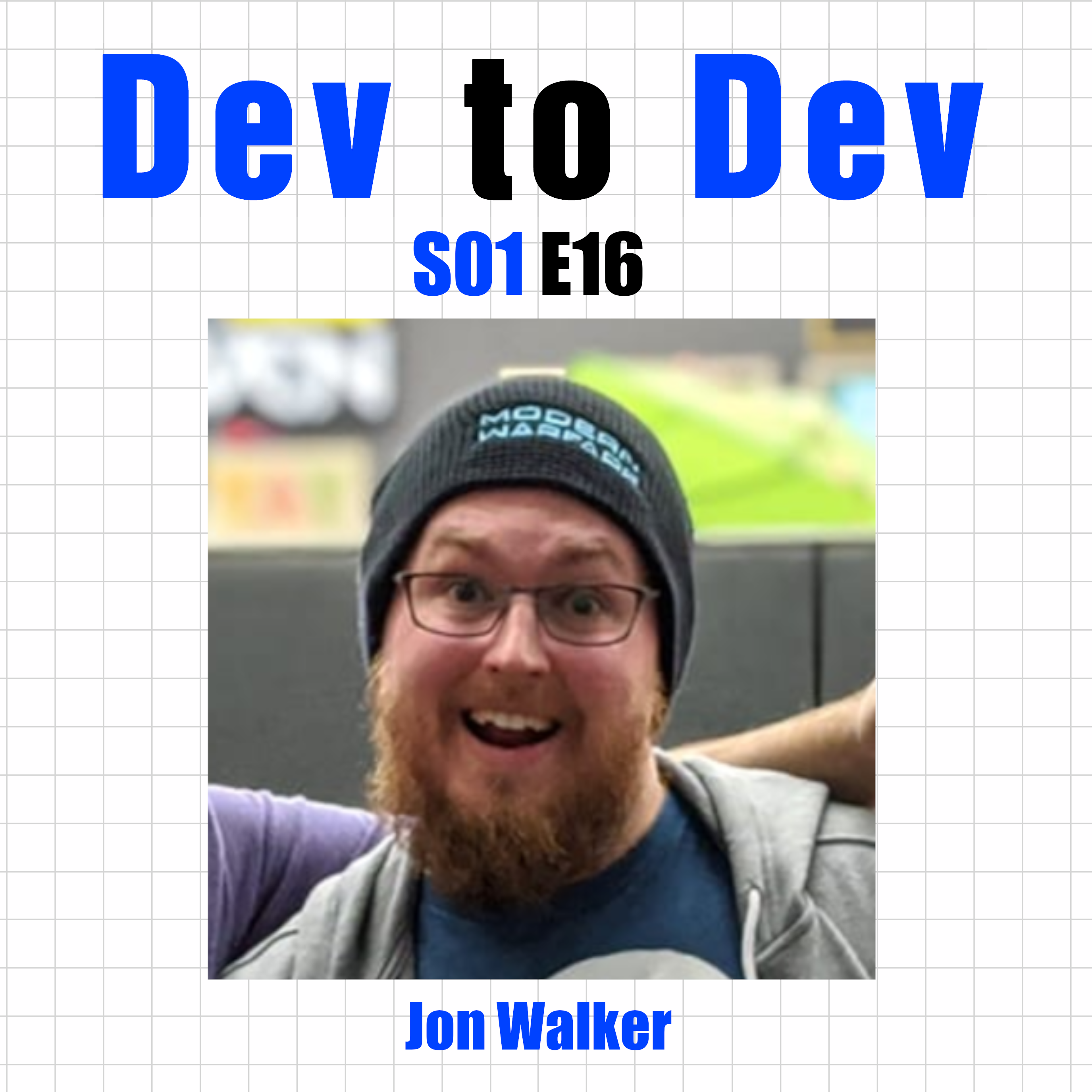
[00:00:17] Speaker B: Hey. Yeah. So recently worked with you, Alex, over at ZeniMax, helping do combat. So I was the combat lead on our last project together. Before that I was about four years at Riot. Did a couple years on Valorant as the competitive designer.
Some people might have seen me there doing Rank Fact Friday. Some of the more like, you know, Twitch interview stuff as well as pretty active on Reddit. And then I did a few years in R and D before going over to zenimax. Then a long time ago I did a game called Warzone.
Worked on about what I think 9 call of duties total. I think the big thing I tell people is I made Prop Hunt, so that was like my big game mode that most people know. And then the last thing I did was Warzone. I did all like the weapon balance for Warzone, vehicle damage, all the items you picked up a bunch of stuff in Warzone, gas circle, parachute stuff. So yeah. And then a long time ago I played esports on consoles when it was air horns and mlg. Just a glimmer in the in the eye of video games and getting a headset for playing was like the biggest, craziest thing. And now people are making millions of dollars. So sweet.
[00:01:24] Speaker A: I love that. That's a good chunk of bits and bobs we can dive into.
I'm really excited about your history because similar to another guest we've had, Joel, you've got some military background and outside of games, into games, I think there's some interesting stuff to talk about.
So I always like to start with my favorite question. What first inspired you about video games?
[00:01:46] Speaker B: Yeah, so I did not have the best childhood growing up. So video games was definitely like an outlet there.
I remember. So I was in foster care and I remember it was maybe seventh or eighth grade. We had to do a presentation about like what do you want to do when you grow up? And I just love playing video games. I think the I remember old NES and Super Nintendo, like raising and kind of getting raised early on and playing those. My mom's roommate had an NES console and so that was like when of my early core memories is like waking up in the morning to play Super Mario while my mom drank her Coffee.
And it just always stuck. I don't know, it was a way that I connected with people. It was how I annoyed the eventual best man of my wedding in middle school to come hang out. And he even told me, he's like, man, I did not like you in seventh grade. But like, you came over and played games enough and then became best friends in eighth grade. So, you know, annoy people till you like them. And then my foster parents told me I did a presentation of what I wanted to be when I grew up. And I want to be a game dev. Right. And so I've always known I wanted to do it. I just didn't know how to get there. And so that kind of led to complicated, you know, how do you get into game dev? And did my own, you know, searching when the industry was younger of getting in. But yeah, that's, that's it. That's why game dev, I just kind of always have loved it and it's just been super, super important thing in my life.
[00:03:12] Speaker A: Interesting because that's not always common, right? People don't always necessarily correlate playing games with being making games. And it's interesting that it obviously connected with you early on. So what, what was it about it that. Was it just because you love video games so much and it was the natural extension or was there something about video games that made you want to make them?
[00:03:32] Speaker B: I think it was.
That's a good question.
I always liked creative things. Like I, in school I did a lot of the art classes. I did all the art. Metals was one that I loved and like, you know, throw throwing mugs on wheels and doing, you know, ceramics and stuff like that. And so I think it was kind of just a natural, like, hey, this is something that is so interesting to me. And I think it helped that I'm actually in Madison, Wisconsin that, and eventually, you know, went to go work at Raven Software. But in, in high school I got to tour Raven Software as well. So like shout out to, you know, Raven being around still after I think they're going on 30 years now in high school, being able to go and see it too is like eye opening as well, being like, hey, I really love this thing. I know I kind of want to make them and eventually like reaffirming it with that tour. But yeah, I don't know, I think it's just, it was a way I connected with people, especially when I was going through like hardships in life. Like foster care was really rough, right? It was like, hey, a lot of it Was, you know, my mom did. Couldn't take care of me. She's a single mom. She raised me great with great morals, but she just had her own struggles. And then going into foster care, it was like a way I could connect with people. And I think, like I said, like, force my friend to be my friend was like a great way was go over to his house with whatever PS2 game we were playing or PlayStation 1 game, it was around that time, or N64. And just playing games was like, how I kind of coped with what was going on in my life. And I think that probably just made a lasting impact on top of me wanting to be like a more creative individual.
[00:05:08] Speaker A: So video games were not just a fun outlet. They were kind of pivotal in helping you make connections, helping you kind of. I can imagine, I'm guessing this, but I guess being in foster care and not, you know, that all being very challenging and also not knowing anyone. Right. Video games are probably a really good way to just instantly connect with people and be able to kind of chat stuff.
[00:05:28] Speaker B: Yeah. I mean, even I'm very guilty of it now. Like, I know the games that I play are more multiplayer focused because they're like, I have such a social.
I love, like, the social aspect of games. So, like, I remember it was Timesplitters and Conker's Bad Fur Days around that era of like, the PS2 and 64, where they were like, actually diving into, like, how do we get people sitting on the couch to play games together more than just two people? And so like Conquers Bad Fur Day had, you know, N64, four players and. And then you could have like eight to 12 bots. It was like the closest thing to feeling like an online match. Unreal Tournament at the time worked on Dial Up. That was also like, one of the PC games that I love playing. So it was definitely social, like, the social connection really early on, which was surprising because, you know, I think Halo, Halo and COD and Battlefield were like, kind of the pioneers of online, you know, at least on the console and matchmaking.
So.
[00:06:21] Speaker A: Yeah, yeah. But that social aspect was very important to you. And. And also, was there a particular aspect of video games that you wanted to make a part of Game dev that you felt drawn to? Or was it just the general concept of, like, I just want to be one of the people that gets to make them?
[00:06:36] Speaker B: Yeah, that's a man. That's another good question.
I think it was just seeing, like, just truly loving games. Like, I remember one of the facts I had and Again, like, around that middle school time, I remember being in class and they're like, what's a cool fact about yourself? And I remember being like, I beat 40 video games. And, you know, and so it was always just important to me. So I think it was just.
It became part of my identity. And I didn't know. I didn't even know what it meant to make games. So I. I never had. I think what's interesting is I see a lot of.
When you get really excited about Dev and actually like helping colleges and stuff that I have in the past, you learn like, what motivates people to make games. One of the interesting things, I think the thing that like, sometimes motivates people to play games is like, oh, I want to make this. Or I have this idea to make this game. Or like, I love this one series and I want to make something like that. I have a nephew currently going to college who loves sort of that, like, scary horror genre. And he has a game that he, like, wants to imitate someday, right? And he's like, I want to make my version of this one game.
And that's his dream. I never really had that. So I just had like, just a love for games versus, like, I know there's people out there who are like, I have this genre that I love or the specific game type I love, and I just want to make that game.
Which also bites you when you're like, trying to talk to people about like, oh, what game do you want to make? Or if you can make anything. It's like, I just love. I just love, you know, a lot of like, what our industry does in the people. And I, again, that social kind of comes through with that versus, like, I had the singular idea or the singular, like, way I wanted to go in games.
[00:08:12] Speaker A: So, yeah, I can relate to that a lot. It's almost like a fascination with how games are made rather than a need to make a game. Right? You're just. You just love the process so much that that's what draws you. And like, I kind of don't care what game I'm making, I'm making because I just love making games. Or I just love that. That process.
Yeah, it's.
[00:08:33] Speaker B: It's a great problem solving too. Like, I remember going, like, making a decision, like, do I go into the, like, be an engineer? And I went to school for it for a little bit. Like, hey, the problem solving is really fun. I really like math, which is also creative weirdness. I found out, like, most creatives don't enjoy Math that much, but it's like a different type of problem solving. It's more like, I always like to say game designs, like half science, half creative. And you don't really get fully get that in just the engineering program world. Like, even if I didn't go games and I just became an engineer, your problem solving is a lot. I mean, it's still creative, but it's a lot more structured. And I think that, that, that kind of loose structure craziness of games is also appealing in a weird way. But.
[00:09:13] Speaker A: Yeah, yeah. Making, you know, solving complex problems that often don't have a right answer. Right. It's like you kind of get to discover the right answer through iteration. Yeah, I agree. That's very much what draws me. And I'm not a massy person at all. So I'm definitely in that realm of not being an engineer. And that's what I'm fascinated about because you. So you went to high school and then you went to the Navy and he went. And, and, and then you went back to school like you said, to study engineering. So through that time of kind of being in the Navy and then, you know, you know, and, and, and I presume video games were still very important to you throughout that time. And then deciding to go back to school for engineering, like, how did that, how did that happen? How did you. What was it that sort of inspired you to go be, you know, go learn to be an engineer?
[00:10:03] Speaker B: Yeah. So in high school, I was taking AP Computer science. And so my history. Foster care is kind of crazy. Right. So it was around fourth grade, issues with my attendance in school started arriving, arising, and it started trickling into leading in like my sixth grade year.
That's where it fully was like, okay, there's things going on. This, this kid isn't getting into school. Court system took over, went into foster care. Foster parents were amazing, amazing people. I still, I'm going to Christmas with them in a few weeks and really excited for that. But then it led to, you know, at near the end of my time in foster care, kind of a crazy story, but I never knew my dad. And he found out in my junior senior year or junior year that I was in foster care. He, I was in Wisconsin. He lived in Montana. He came back and got me out of foster care. And that kind of like shook up my junior, senior year. So I was going to school.
I had a lot of freedom given that my dad was kind of like trying to live in two states at once. And I did not become the best my Senior year of high school as one with a car and freedoms that they probably shouldn't have, like their own place.
And so even though I had a computer science class that was ap, I ended up, like, not really doing much in ap. I did a lot the year before when I was in junior year and I was kind of in a more structured place. But my senior year, it fell apart. And I remember it got to the finals. I failed that AP class. I did get the college credit, or the credit because you have to take a test to get the credit.
But I ended up on the final of the class making something amazing. It was a full vending machine with a debug menu and all this stuff. And I fell in love with it. And the teacher's like, you did so well. I'm going to give you a C for the class because clearly you understand it, but you're not getting your college credit.
[00:11:53] Speaker A: Right.
[00:11:53] Speaker B: So that, that whole like a doing really bad senior year and then kind of like, you know, falling in love with like engineering in the last week of the class or like, it was really java was like, man, I should just do this. This is how I get into games. Like, I love the problem solving aspect of this and then kind of use creativity to solve that problem. So oddly enough, that's how I learned that I should get into engineering and then went to college, did kind of the same thing. Coming out of like, no structure, had a car, doing whatever I want.
Led to me going to a private college, which at the time private colleges were like, you have a game dev degree. But they didn't know what that meant. So it was like, you paid a lot of money for not the best degree, which that college, the one that I went to, is now gone. So they did not do well.
And then after realizing I was racking up debt and not doing too well in school, I was like, I'm gonna just go to the join the military because I don't know what I'm doing.
And then once I kind of got my life in order in the military, really helped straighten out, you know, the craziness of foster care. Out of foster care.
Family stuff going on after the military is like hyper focused, like, okay, gonna be an engineer. Started that process.
My wife, we got married while I was in the military, super, super supportive. And, you know, as soon as I got out, I got a summer job at Raven, um, and kind of just went from there. So didn't. Didn't end up finishing my grief, so.
[00:13:17] Speaker A: Right. Oh, I see. Interesting. So, so you did Kind of a year at Madison Technical College.
[00:13:23] Speaker B: Yeah, yeah, yeah. So, man, that's a crazy story about how I got into the. To the game industry. So, yeah.
[00:13:31] Speaker A: Did.
[00:13:31] Speaker B: Went to the Navy. One of the cool facts there is I literally went around the world. So I was an aircraft carrier. Started in Washington State. We, you know, went around, ended in Virginia. I did two tours floating around the oceans in the Navy.
And when I got out, you know, I was in school and in college before I joined the Navy, I played esports. And it was kind of like, it. There's. It was like, very early. And like, I said, it was not really like, you know, it was like getting a headset from a sponsorship. Like, getting Turtle beach to sponsor you was, like, the craziest thing ever.
So we had a pros versus devs match in when I was in college with my team because we're one of the best teams in the original Call of Duty.
And I kept. I added that person on Xbox. So while I was in the military, we were in. We went to San Diego a bunch, and I was like, hey, could I, like, drive up and meet you and just message this person on Xbox? And he's like, yeah, man, bring someone out and, like, come visit the studio. So I drove up to Infinity Ward from San Diego, rented a car. Like, we. We made port in San Diego. My ship landed, drove up there. Oscar Lopez, if you're watching this Infinity Ward, he's still at Infinity Ward. Great dude.
Took me out for sushi, showed me an early, you know, Modern Warfare 2 made. It was a really big deal for my career.
But then when I got out, I started Twitch streaming randomly. Saw the job posting for QA at Raven after. I was like, you know, coming back, going to school, and I was like, I'm gonna apply for a summer job. Applied for that.
Talk to Oscar again.
Oscar is like, hey, yeah, you should definitely chat. He helped me out. But then also, the kind of other crazy turnpoint is I was watching a Twitch stream. Was in that kind of scene, and they're giving away free beta keys for a game. I won the beta key.
That stream that I won the beta key from. I asked them, I was like, hey, I don't have anyone to play this MMO with. Can I join your guys? Guild. You have this Twitch talk show. They let me in. It turns out one of our old co workers, Chris Lynn, was in that guild as well, who worked at Raven Software. And he also helped me get an interview. I was like, remember, like, winning this beta key on Twitch, joining a Random MMO guild from it and then being like, hey, I got this. Like, I just applied to Raven Software. I'm really excited. And they're like, you know, we have people who work at Raven Software in our guild.
And I was like, so that's how, like, winning this random beta twitch key and also playing esports kind of helped me connect into the game industry and get my job interview, which is just a.
Everyone you meet in life is important. Right. And so, like, it's just very, very interesting that, like, if I didn't witness beta key and Twitch or I didn't play, you know, console esports and Call of Duty, I might have never gotten to the game industry that quick or that, you know, without a degree.
[00:16:13] Speaker A: So that's mad. I love it. And. And so, yeah, and it sounds like a huge passion for Call of Duty as well. And presumably understanding the. Yeah, the way that game worked probably made you stand out as a potential.
And then you get. So then you get the role.
Raven as a tester.
[00:16:30] Speaker B: Yep. Yeah. And then, yeah, did a qa. And they learned pretty quickly that, you know, because scripting is a lot like, I mean, if you're a really good engineer, you're probably a really good scripter because they're scripting languages are built to be worse. Well, at the time were worse versions.
[00:16:43] Speaker A: Fisher Price coding.
[00:16:45] Speaker B: Yeah, exactly. Yeah. Like, scripting was like, you had less stuff you could do, but as C basically right in the COD engine. So now with blueprints and stuff, it's getting so much different. Like, there are some designers that being a designer and like, being a good scripter is completely different than being a good engineer. Right. Which. But I'd say back, you know, back especially in the 2000s, before scripting was usually just like, you're some form of a engineer light. Right.
So, yeah, it was a good time. And I think I really thankful for the people who helped.
[00:17:19] Speaker A: Right.
[00:17:19] Speaker B: Because Chris Lynn, obviously meeting him and he worked. He was my producer on our last project. So it's good to reconnect with the person who literally helped me get in the game industry. And then while I was at Raven, Daniel Loan, who's also at our last project, he was the one who referred me from QA into design. He was like, hey, we have this QA person who knows how to be an engineer kind of, or knows how to script, really. And he has a background in Call of Duty. Like, he would be a great designer. And he kind of advocated to get me into design. So it helped me break out of QA into design, which is always, you know, if you're in qa, you're trying to find your break any way you can. So.
[00:17:58] Speaker A: For sure, yeah. Especially internal qa. Right. If you're internal to the actual developer, then you're talking to the developers as you find the bugs, and that's a good way of getting. So, yeah, talk to me about the transition. So you were kind of QA for about a year working on, you know, Colin Line and a couple of other CODs.
Um, and. And so you mentioned scripting as part of those. We scripting, you know, we engaging with the script as part of your bug testing, were you just kind of digging into script for fun? Like, how did that happen?
[00:18:25] Speaker B: Yeah, I did not really get to mess with scripting much.
The. I did some, like, mod stuff, like older CODs. I can't remember what COD at the time. Every once in a while, coddle. Like, the last one, I think was like, Black Ops 3 will re up and be like, you can. There's mod software for this and you can go like, mod it. And so I tried to do that, but I think the big thing was like, Loan was going on paternity leave because he's having his son. And they were like, hey, this loan at the time was running the store for Call of Duty Online, which is free to play in China from Tencent. And they're like, hey, we don't have anyone else to do this, and we need to keep making money. It was essentially like the problem. And Loan was like, hey, I got to find someone.
And so the timing just kind of worked out where he recommended myself and a couple other people. Um, and yeah, I didn't. I didn't have a chance to until I moved over. And then I really dug my heels in. And that's actually why I made Prop Hunt. So I made Prop Hunt in the COD engine because a. I loved. I loved the kind of, like, how it played. And it was already existed in counter strike and TF2 at the time, and I really liked those versions, but there's some things I didn't like and I wanted to fix. And I was like, man, this would be great to throw in Call of Duty. And so I made it for Call of Duty Online and kept begging for like a year. I remember a year of being like, hey, I got this game mode I made. Like, please, let's play it. Like, let's try it. And then eventually play testing it. It went really well, right? And then eventually you're like, oh, okay. Like, let's put it into Call to be Modern Warfare Remastered and then it did. Amazing. And then like porting it over to future cards and just like falling in love with design. And that. That making Prop Hunt was how I essentially like learned how to really script in COD engineering and then like really learned like what kind of more about making game depth stuff. It was like, you know, there's like weird vector math and all these other things you had to do. And like how do you didn't have the support and the small team with COD online to make the ui. So like I had to go make the UI and all that fun stuff. So that's how I kind of learned to script and break in. Was kind of just thrown into the fire. And then while I was there, I was like, I'm going to work on something on the side in the engine. And that was Prop 1.
[00:20:22] Speaker A: Cool. Yeah, that's. That's fascinating. And sort of the benefits of being, you know, relatively new on a small team, you get to wear many hats. And if you've got a passion for the subject matter, which it sounds like you did with Call of Duty, then you get that good opportunity to kind of learn a broad base of what game development is. Yeah. Like you say, from UI to scripting to standing up game modes to that kind of stuff.
[00:20:43] Speaker B: Yeah. What did you. When you were in where was like, what game was like your original. Like where you learned to script and implement. I've never asked you that before.
[00:20:51] Speaker A: Great question. It was probably. I mean, it was officially primal. That was when I officially got into the mapping and editing and scripting. But I did quite a lot of it in my QA days. I was. Because I was again, I was first party QA as well. I was internal qa. So I did the similar thing where I was like, hey, I found a bug. Hey, can you show me how do you fix that? And then I just sort of through osmosis sort of picked up the mapping and then I started using the mapping editor in the evenings and you know, plus I was doing a lot of scripting at home. I was scripting Quake and Doom levels and stuff like that. I sort of. I built our whole office in. In Quake and we had a death. It was awful, but I built a whole office in, you know, for a deathmatch map. And so I was kind of mucking around with editing and scripting that way.
But primal is when I sort of really got my, my, you know, I was like, okay, you can officially go and do it as your day job now.
[00:21:45] Speaker B: Yeah, no, I think, man, that's embedded QA is so nice for that. We didn't have too much. I was just on the tail end of that kind of ending. I think that the early 2000 and tens is like, that's where embedded QA starting phased out more. And like, I was just in right before that. But yeah, we didn't have. I think we had some like, level editing stuff you could do and they had like, you know, you'd have mentors and people help you, but we weren't allowed to too often get into script or look at things. But it's funny you mentioned the, the Home office thing or the home office. The office level. But because Raven made Soldier Fortune and they had a level that was their office before they switched offices. So, like, when they made like a deathmatch level for Soldier Fortune, that was their office layout. They're like, should we be concerned that we're like, they released an official map in Soldier of Fortune that was, you know, the same layout as their office.
Yeah. Crazy times. Like, it's just, you know, you don't realize how much outside of game dev, I. I would love to, like, just all the little things that happen in real life and your inspiration is like, found all over games. Like, it's just. You don't realize it, but there's just not little nods everywhere of people's like, inspiration. Like the level, like the office level, right?
[00:22:57] Speaker A: Yeah, yeah. Stuff bleeds from people's real life into the games and back again.
So, yeah, so you're kind of listed as a system designer, you know, kind of junior associate system designer. It sounds like it was broader than system design.
It was almost more technical design as well.
[00:23:13] Speaker B: Yeah, yeah. I think that's something like you're probably familiar with especially, you know, I think systems design is like, we're still learning what that means because, like, when I, whenever I used to interview early on in my career, systems design meant like an engineer doing like complex infrastructure on the system work. Right. Like, sometimes back end.
Sometimes people would also think of it as a networking thing. So systems design, whenever I went in early for interviews or talks or people asked me what I did, they'd always be like, oh, was here some type of like, backend engineer? Some system architect engineer. Right. And I was like, no, it's not what I do. I'm a designer, blah, blah, blah.
Raven did not have design, like the game design title. They had three kind of design groups. One was systems, one was level design, and the other was gameplay engineering, which was kind of like what we know as tech designers now, but they were full engineers and so which you talked to Nick Heindle. Nick Heindle being one of the gameplay engineers turned into tech designer over time.
I was one of the system designer and system design was like I handle a lot of weapon stuff, challenges, all the economy stuff. Like, like one of my co workers that is pretty close to. He handled a lot of the like economy slash, like mtx, you know, all that fun stuff.
I did a little of that as well. And then oddly enough, just because we didn't have level designers, game modes and stuff. So that's why like I led to me and Warzone having such a big hand in Warzone is because there's only three of us that was like actual like game design scripters on the project. So it was me, it was actually four of us, but me a junior that was just joining the team and he kind of did missions and then my boss who was a associate creative director on Warzone and he didn't really implement, so even he was former engineer turned associate at the time. So yeah, it was kind of like you did everything. Even though it was like a systems design, a lot of it was game modes as well as like math and weapons.
[00:25:06] Speaker A: So yeah, very similar. I mean going back to that, that game I worked on, Primal, it was very similar. Right. It was two designers basically. We had a third designer join later on. So yeah, it was level design, it was system design, it was combat design. It was mostly combat design. But yeah, when you're a small team building a large project, you often do get quite a lot of freedom, right. To explore. You're not sort of like, oh, you only do this avenue, right. You can do a bit of this, you can do a bit of that. You kind of just muck in and get stuff done. It can be really fun.
[00:25:33] Speaker B: Yeah. Which is like, you know, it's interesting because we're seeing this like ballooning of the industry, I feel like where it's like early on I remember that you had to wear many hats and like teams were the size they are now and now triple A dev is ballooned, which, you know, of course, more money, more problems, bigger, more platforms, all the, all the problems that come with making aaa. But I, you know, did you. It's, it's interesting to hear that you also had that same experience where it's like, yeah, originally you had to wear many hats to be able to do many things. And then now it seems like more people are getting specialized and strut and game Desk getting stretched out. Right. And then now it seems like we're snapping back where it's like, cool. We can't just have someone who does this one singular thing. We need someone that can implement and do many hats. And we're kind of seeing that, you know, rubber band again, where now they're, They're. The industry wants people who can do a lot of different things versus, like, the specialists, which kind of is. We've moved towards specialists for the past decade.
Has that been, like, your experience? Have you felt like you've seen that through your game dev career? Because you've been in longer than I have, so.
[00:26:28] Speaker A: Good question. Yeah, I feel like I have, I think definitely the sort of intense specialties that we see, I think less so in design. I think design in general, we tend to be more flexible.
[00:26:40] Speaker B: Right.
[00:26:40] Speaker A: I think just by the nature of our job, which is sort of hard to define sometimes. Like you say, some studios completely define designers differently to others. Whereas, you know, engineering, I think engineering, you see a lot more specialty in engineering. You see a lot more specialty in, you know, in art. I think you see a lot more specialty in animation.
But I would. I definitely agree. I feel like, you know, team size, increasing team size has allowed people to narrow their focus more, you know, probably be more effective in that way.
But I do think there is, yeah, increasingly a need across the breadth of the studio, of the. Of the industry now for people that can be a little bit more generalists and, oh, you've done a bit of this and a bit of that and a bit of this, and you're, you know, you're kind of decent at all of it. That's a strength as opposed to. Oh, you're excellent at that one thing. Okay, well, we better find.
[00:27:29] Speaker B: Yeah, the right spot.
[00:27:30] Speaker A: Exactly. Yeah. Yeah. Camera design was always one, you know, like God of War games I worked on. Right. With very fixed cameras. We had specialty specialists that just did all the camera work and they were awesome at it. Like, they were really good at framing.
[00:27:42] Speaker B: The wizards in the castle that you'd climb up to. Like, I have this one camera problem.
[00:27:46] Speaker A: Yes, they were all. But that, that, you know, that version of that role has almost completely gone away now because games are so much more, you know, full. Full twinstick control. Right. That. That specialty of, like, fixed camera framing, you know, that was crucial to go to war at some point. And many other games, dmc, Resident Evil, like many other games at that time, has just kind of gone because, you know, the way the games have changed and they have to Be more generalist now. So. Yeah, I think that's fair. I think it's fair to say it's kind of stretched and maybe retracting back a little bit.
Okay. Yeah. So so many CODs throughout the sort of system design role. You mentioned Warzone having sort of a big impact on, you know, on Warzone.
And then you make the jump, you make the jump from, from Madison. You're at Madison, so you're at Raven for almost six years.
And then you make the jump to California and, and to Riot. Like, talk to me, how did that happen?
[00:28:38] Speaker B: Yeah, man, another crazy story. So I lived in Seattle when my, my ship was stationed in Washington and I went to PAX 2011 and at the time I actually played League of Legends and beta. Loved League of Legends, like loved that game, was all about it.
Played it whenever I could in the military. So when you walk off the ship, like you walk down the pier and there's like a restaurant at the end of the pier and where, where I was stationed at and there's also, it was also an Internet cafe. So like you'd go there and there'd be two things people be doing. Everyone had their laptops, laptops out and they're playing World of Warcraft or League of Legends. So those are like the two main games. Or you're in the barracks with your console playing COD or Halo.
So I got really into League of legends and then PAX 2011 rolled around as in Seattle, and I went out to PAX 2011 and I knew, like I said, I knew I want to be in games. So I went to the League of Legends stand with Riot on it. I, you know, bothered some of the devs and they're like, hey, you should come out to this, you know, game dev meet we're having afterwards at this local bar. So went there, got a card from.
His name was Pen. Riot Pendragon. I don't know if he's in industry, so I don't want to like drop name, drop him and Morello, which Morello is still in the game industry making games and he's an awesome, awesome dude.
I was in the middle of the ocean emailing them, being like, hey, I'm getting out in like two years. Is there like a chance I can get a job? And they had the community manager position. So I remember interviewing for a community manager position at riot, like 2010ish, May 2009 on a satellite phone in the middle of the ocean. It's like cutting in and out as I'm trying To talk and convince them to hire me in Game manager.
Didn't get the job, but I actually got pretty far along. The interviews for someone with no game dev experience is pretty cool.
And I knew I always wanted to work at Riot. And as I obviously the decade goes on and I get further into game dev, the opportunity kind of lined up where they were looking for something. I had a friend from Activision go over there, refer me over and I was like, hey, I just launched Warzone. I was pretty burnt out at the time, at the beginning of COVID and we were launching a live service that started Covet was crazy.
So I went for it. I interviewed Riot has a really, really tough design interview process.
High, really high failure rate. And yeah, I got the job and I was like. I remember going to my wife and being like, hey, this is always a dream of mine. Like, I want to go work at Riot. We were living in Wisconsin at the time. Our family was here because somehow we lucked out having Raven and being able to work at a studio where your hometown is pretty cool.
And yeah, I want to challenge myself and go work at one of the biggest, you know, studios and one of my favorite games and it wasn't, you know, League of Legends. I, I loved Valorant as well because I love shooters. So it was a no brainer. So, yeah, accepted the job. But I remember when I was starting, I opened the email thread that I had with Morello because I still had it in my Gmail and I was like, hey, surprise. I'm starting in like two weeks. By the way, I think you're my manager.
And then he was like, oh, this is awesome. He's like, yeah, normally I would be, but unfortunately I'm going to a different studio. He went to Fraxis.
So it was just really, again, small world, like game. You realize when you're in the industry how small it really is.
Really cool experience. But yeah, so I'm picked up and moved out to LA and you know, did that and I got to work at what was kind of my dream studio. So, like, I'm very happy with where I, you know, where I'm at in my career and I got to do the thing I wanted to do, so that's cool.
[00:32:08] Speaker A: And again, it sounds like it comes from a passion for what they do, right? You had a passion for COD and you ended up working on it. You had a passion for League of Legends and, and all right, you didn't end up working at Legion, but you say Valorant too. Like you had a passion for for what that studio created. And you got to go there and see it from the inside and get to work on it.
[00:32:25] Speaker B: Yeah, it was a great experience, which, I mean, you know, we talked, I think when we worked together, we talked to like getting to work on.
It's weird because I think you hit a point in your career where like, you know, early on you're like, oh man, I love these games. I want to go work on them. And then you work on them and you're like, I did it like now how do I challenge? What do I do? How do I challenge myself? What's next? And you kind of like set weird goals for yourself. But I'm definitely at the stage and I think we talked about it. It's like I'm just really happy working with great people. Like I'm at that point in my career where like, man, I just want to work on something that I find exciting with like great people. Because you know, you realize that like especially going and making it that like it's, it's hard. Game dev is hard, right? So yeah, definitely.
[00:33:08] Speaker A: And so working on, you know, I know you worked on some R D stuff that you can't talk about, but in terms of kind of the valorant stuff like how, how you know, Cotton Valorant, right? Similar, but very diff, you know, very. Also very different, you know, in their approach and what they're going for. Like how, how did you find that transition? Was it challenging? Did you, did he fit right in? Did you feel like as you knew the games, did you feel like it was a natural transition?
[00:33:34] Speaker B: Yeah, it was, it was interesting. So COD was like a well oiled machine, right? You're launching a new COD every single year.
Roughly every year. Sometimes it's a year, but you know, it has it down pat like and you're working with three different studios. So at Raven, you know, they, they help out finish almost every single cod. They do things in, in various titles. And so you're always like moving to the next thing. It's always kind of crazy to Riot at the time having two big successful live services, right? Like kind of one of the like pioneering live service, right? Free to play live service.
And it just moved a different pace. I remember going there and feeling like I wasn't working enough. Because cod, you're always just sprinting to release, right? And Riot, you're like, no, we want to make sure we're doing the best for the like player was a huge like live service. Focusing on the player is a huge focus there. And it was actually really hard. It was hard slowing down and being like, no, I have to be like super mindful and take my time and make sure that like everything is just like on point.
So that was a little difficult, like learning. I think one of the things that they really reinforce that I still kind of hold I value heavily is like how much they valued the player and making sure that you got it right and then really focusing on like knowing Goal driven design, I think is something that like really can be difficult because like when you're used to moving fast, you sometimes will just be like, ah, I like this idea. I might not know why. I might have an idea of what the goal is, but like, you know, I just, I played this one game and I love the system and I'm going to make a version of that, right. I'm going to put it in our game and I have to move fast. I have to make something. So I'm just going to make it and do it versus like Riot's like, no, what's our goal? Like, what are we doing?
Let's break down and like take time. Let's survey players. Let's do, do this. Like, so it's, it's a little more slower than what I was used to, but also more thoughtful in goal driven design and having to convince a lot of people who are really good at the game, everyone at Riot really cares.
A lot of them are very, very good. At Valorant, our play tests were insane. Of the top 500 players in ranked, there were some of them on the Riot dev team, former pro players.
And so you kind of go through the gauntlet of design there and convincing people of your design. It was a, a good experience. Yeah. Different pacing and also just a lot more eyes on your design, I think, which is like what made it, I think tougher but also really good place to grow and learn. So really valued like my time there.
[00:36:00] Speaker A: Yeah, it feels like that's the right way around to, to get it right. The sort of slightly more ad hoc, like go with your gut kind of broad experience that it sounds like you got a Raven to the more methodical, more foundational, more kind of philosophical approach that you got a Riot that I'd probably rather it that way around. I feel like if I'd started with the philosophical, it might have given me a good grounding, but then I would have hit Raven been like, oh my God, what? How do you. How can you achieve anything? Yeah, exactly.
[00:36:29] Speaker B: Yeah, I worry about that a little bit. I mean, I kind of like talked about the rubber band we were talking about earlier, I think I told you this when we were on the team last is it's, it's really difficult because so at live service you don't need like you work on sometimes a smaller, very focused problem for a long time and sometimes, I mean, there's a lot of designers in live service and this is nothing against those designers, they solve problems differently. But you don't have to implement a ton or you don't have to heavily implement. And so like I remember going from, you know, working on a live service, this is even true in Warzone, like Warzone, you have to implement a little bit heavier. But when you get into the flow of everything and you really get like what you do in your job, you're not challenging yourself as much or maybe you're losing old information of like implementing that I used to use or not used to like upkeeping. So I remember having to like specifically when I wasn't, especially in the role I had at Riot, being a competitive designer. I worked on matchmaking and math and ranked systems and a lot of front end and back end work, but not a lot of like design scripting.
I remember being like, man, my implementation skills are falling apart because I did, you know, years of not actually being in heavily in engine and more on just like front end UI design or like algorithm math that I passed to an engineer. So it's definitely difficult. Live service is interesting. I could definitely see where like that approach and needing to learn how to implement and implement quick is like a super valuable skill that I think is also the industry struggling and how to figure out sometimes. Right?
[00:37:51] Speaker A: Yeah, yeah, definitely. And you mentioned competitive there. I mean, you know, obviously social and sort of a level of competition has always been a part of why you love video games by the sounds of it. And you know, going into a company like Riot and sort of working on very tough competitive problems, that's a different sort of mindset to building, you know, a single player or, you know, a more individual player focus as opposed to more the kind of broad experience, the competitive experience. Right. The quality of that is, is there's a lot of minutia there. Like did you find that challenging? Did you find that your skill set, your sort of passion for that, you sort of had a good head start. Like I think I would struggle right, going into true competitiveness because it's not necessarily my bread of butter, but it sounds like it was yours. So did you find yourself able to adapt to that and adapt to that level of design fairly easily?
[00:38:44] Speaker B: Yeah, I think I did. I think that being that I favor more social games and having that competitive background definitely helped.
There's, you know, luckily someone started around the same time I did or maybe it was slightly after. Before. His name was Josh Menke. He did matchmaking over on Halo. Halo, kind of one of the pioneers of matchmaking. Skill based matchmaking. Working on True Skill 1 and Halo and stuff like that.
So I'm very lucky to have I had access to that person because I remember pulling Josh aside and watching his talks at GDC and being like, hey, like I have this problem, like what do you think? How do you solve this? So having them and I think the just in general, I had a great manager. Joe Ziegler is the project director. He went into R and D which I also followed Mar and D. And then he I think ended up somewhere else in the industry. I don't think he's that right anymore. But him and a guy named Max, just great people to be like, hey, I have this in competitive. The biggest issue is that and I struggled this my career is you want to make decisions that are good for everyone, right? Not just the competitive players. I mean depending on your project you might have more of a competitive focus, right? Being riot, right. They're very competitive and ranked is very important to both Valorant and league.
But you still have a whole player base that is not competitive or doesn't care about competitive.
So you have to be like very mindful of it. And I think I struggle. That's like something that's kind of come through my career. Like I remember joining COD and people would be like, oh, like I, I was very clearly the best in the studio at the game for a while. Like I have, I think I have a picture of me winning one of the, one of the in game, in house tournaments with the trophy. And I'm like, it's kind of unfair because I play competitively. But I've had to fight that my whole career where it's been like, hey, are you're too competitive? Like, are you too competitive? Do you even understand the casual player? And it's like, no, like I, I don't play esports anymore. I, I understand that world very well. But I also understand, you know, my, my wife through our, you know, relationship together, grow, growing up together, she just started playing games and went from like, I don't like competitive games, I don't like PvP. And so like it's very interesting having you know, this person that I'm connected with go through their gaming journey. Note not Competitive at all versus I'm like, yeah, I'll play a competitive game from time to time or sometimes I really enjoy hopping into a ranked match.
It's difficult. And I think that when you learn like who you're kind of, you know, especially at Riot, they did this really well. Learning at like what groups you're servicing and like what they care about, what they find important. And if you're able to talk, I think the one thing I really appreciate and it can scare people and it can, it can be very bad for your studio if people say the wrong things. But being able to talk to players and like see and break down problems with them.
Like I remember at one point in Valorant I was on Reddit all the time talking about how our matchmaker worked because Riot let me and talk about like why certain things that players thought were happening wasn't true or what maybe telling that what they was happening was true and why and explaining to them.
It kind of helped the Reddit community. I remember at one point there's someone in the Reddit community that like really would like save links of all my descriptions about how things worked and when people be like, hey, why is this happening in competitive? They would link to one of my responses on Reddit, they'd be like, oh, this is answered here right by Evermore and blah blah, blah, you did this. And I think that it's, I really liked that if competitive is about the people and like the social aspect and competitive play, like really making sure that you're talking to the players and like can do that was really, really helpful at Riot and I think that that really helped me understand that mindset better. But also it's tough. Designing for competitive is tough and I do think that it helps a little bit to have a background, but I think it's just getting in there and diving in like any, any problem and learning the player base.
[00:42:17] Speaker A: So yeah, and you're right. There's nothing more sobering than having what you think is a great idea just get absolutely destroyed by the community or a play test or something. You're like, oh no, nothing, I have way out of a touch. Yeah, it's very.
[00:42:30] Speaker B: So yeah, it's the, the humbling. Like it's the, you know, when you first get in, you're a designer, like I'm gonna make everything amazing. And then like your first Kotaku article, which I had, one of the game modes I made after Prop Hunt was like, this Kotaku article came out that was like, this is COD's most ill received or ill designed game mode in. In decades or ever or something. And I remember like printing that article and I was like, that was my game mode and like holding it up as like a badge of honor. It's hard.
[00:42:55] Speaker A: It is. But it's important. Important to go through that.
Okay, so. So you move from riot over to. To where we work together. Zos talk to me about leading people. You know, when did you start taking on reports and like, how did you find that transition?
[00:43:12] Speaker B: Yeah, man, I did it in the military. So when I was getting out of the navy or when I was in the navy, at the end I was, I worked in security. So for a while.
My military journey is also very funny. I joined, I was like, I'm going to be on a sub and I'm going to work on sub stuff. And then got engaged while I was in or right before I went to boot camp. Or maybe it was in between boot camp and school. But I knew it was leading up to engagement as I joined the military and I was like in boot camp talking to this person that like, pass to pass or fail you if you can go on a sub or not. And he was former submarine. He's like, yeah, you go out for two weeks, you come back for two weeks. You go out for two weeks, you come back, you're like rotating with another squad. I'm like, man, I'm about to get married. I don't want to be leaving every two weeks and then coming back.
I don't want to be on a sub. They're like, well, you can either be a cook or you have to go back out and go find it and like, wait to find another job.
And I was like, I don't want to do that. I'll be cook. So I thought I would be a cook after being like going to be a sub technician.
Ended up hating it. When I got to my, my ship, I was like, man, I learned a lot about cooking. I got to be the captain's cook and stuff, but ended up doing security, which I changed jobs after about six months into being security. So doing like military police on the ship kind of is basically what it was.
And then we focused on like Somali pirates or, you know, base defense, like when we went to foreign countries and stuff.
But I had a point to this. Where was I going?
[00:44:37] Speaker A: Leading. Leading people.
[00:44:39] Speaker B: Oh, leading people. So that led to me having a section of about 30 people that I led at the very end of my military career.
And I debated about staying in because I was like really loving it at the time. But I think that that taught me a lot. And the one thing I kind of carried over from someone, a mentor there was kind of, everyone has to go on their own journey. Like, it doesn't matter if you tell people what the right thing is to do. Because I had a friend that unfortunately, like, you know, made some bad decisions, got kicked out of the military, but. And I tried to help him and he's like, hey, sometimes people, you can tell them all the things, but they need to go and learn themselves.
And I think that really started to develop. And I started understanding that at Riot when I heard my first few direct reports and understanding like, hey, I could tell them what I would do or the right answer, but that's not going to teach them as much as them going and learning and then having to figure out like, hey, there's some level of you need to guard rail, you need to set goals properly, you need to do this. But I do think Riot R and D was my first real experience of like, you know, leading people. I mentored people through the years, but understanding it and actually having direct reports in R and D at Riot was the first time I was like, man, this is really what it means to lead people and have someone. And it's tough. It's like, man, you don't realize the problems you have. So you start, you know, actually being in that space in learning how to like, best guide and help someone out with their career.
[00:45:52] Speaker A: So yeah, yeah, but it's great that you got some grounding, you know, before that, that you weren't sort of thrown into it. I know the first time I led people, I had no idea. I didn't have kids, I didn't have any. I couldn't barely leave myself, let alone lead other people. But if you had some grounding in.
[00:46:06] Speaker B: It, the best way to learn, right, Getting thrown in the deep end here is like, I mean, that's we. I mean, I've seen that problem too at studios where like people like, oh, I want to go. It's this weird thing in the game industry where it's like, hey, I should go. If I want to be a director, which, you know, I dream eventually someday to be a game director, you have to pretty much go the more management route. Cause you're going to be leading people.
And some management routes are like, strictly your job is just managing people. And some are like, ah, you kind of have some direct reports, but you're still designing and implementing. And then there's the principal route, right, where you're mostly just implementing and you're handling, like, your own designs for big systems. And a lot of studios, like, push you more towards the manager route to get director. And then some people realize very quickly that they're like, oh, this isn't for me. And I've seen it at many studios where people go the manager route and they're like, oh, I have to switch back to principal. And then the studio has to deal with like, that. And it's tough. Yeah. Figuring out that. That jump in the deep end. There's like a certain point where it's like, not easy to explain it unless you do it right. The Peter's principle. Fail until or get promoted until you hit that failure point. And a lot of the time switching into management is that point that people really struggle with.
[00:47:08] Speaker A: Yeah. Or you get that classic case where, like, one of your best implementers, someone that's kind of leading a key part of the game, also has to then lead people and they get horribly torn between.
Well, they have to. Exactly. They have to lead people because they're so senior, but also don't. They. Can't they just do the implementation because they're so good at it? Like, you end up with that. Yeah, yeah, I've definitely seen that happen before.
Okay. Yes. So see, see, jump over to Zos, you know, and. And join his league Combat. Um, that. That was a very different project, I think, in some ways to what you were working on at Riot. But also, you know, kind of experimental. Right. Still trying to sort of find its way. A new ip, new, new project. So how was that transition?
[00:47:48] Speaker B: It was good. I think at that point, my career, I was worried about two things. One, being painted as, like, only doing shooters. Right. I'm still fighting the competitive COD guy image that, like, people would paint me as when they first saw me or met me.
I, you know, remember talking to people and having to, like, you know, convince them I'm not just a competitive player. Like I said, kind of throughout my whole career, it was awesome. It hit at the right time because I was coming off an R D project. You know, one of the reasons, and I'm very open about explaining this, like, people sometimes, like, not explaining why they left certain projects. But I loved that project I was on. I Love the People. It was an amazing project. I wanted to move back to Wisconsin and my wife was missing her family. So it hit the right time where, you know, you. The ZeniMax project.
One of my mentors, Kamel, reached out to me. He's like, hey, we need someone to lead combat. You and I talked and you're like, man, this, you know, you'd be great. And then kind of went through the interview process.
It hit at a time where I just came from, you know, being in an R and D space and then being like, hey, this is how I've seen these problems solved in the past. Learning from COD and being able to be like, I'm going to figure out how I do this kind of my way. And I think that, that joining the team and having your support, like again, thank you.
And then figuring out like what does it mean to build up like truly build up a space and like what is the best way to do it. And I'm, I mean I'm proud of what we were, we're working on and making we. It feels like everything was coming together.
You know, people hear things on stuff. But yeah, was tough and I think it was eye openening to be like no. 1. What I've discovered in the game industry is we've been changing so much and especially in the past decade have been changing so much that no one really knows like the perfect way to make a game. If everyone knew like the best way to do agile, to do like the, the, the, you know, the setting, the vision of the game and the pillars and all these things, like we would just have hits and crazy games all the time. But truly no one knows and everyone's coming up with their own process. And I think that figuring that out, that last project really was like no one knows what they're doing. It's like, it's like when you're a kid and you see adults doing things and you're like, man, that person is an adult. They know what they're doing. I can't, like I, when I get that old, I'm gonna have all my together and it's just gonna work and I'm gonna be adult like them. And then you get to that age and you're like, I have no idea what I'm doing. Like I'm not an adult. Like I can't believe that I thought that I would have this all figured out and game does the same way. So that was kind of the eye opening moment for me is like, all right, we're figuring out what we're doing and how we, how we make games and I'm coming up with my process and how we do it and I kind of just. You develop your own style and that's what I think. Zenimax Truly locked in how I think I like lead and make a game and make an Area of a game versus just like a feature, right?
[00:50:42] Speaker A: Yeah, I love that. Yeah. Yeah. Even though many of us have been making games for a while, right? Every game is its own recipe, every team is its own culture, and you can't just smash the rules from one. You know, this is how we did it here. This will definitely work here. No, it's all a mind meld, right? And I think when you've got a lot of experience, you know, much of us on the project did. We all had a lot of experience. It sort of was the best version of that, mashing together, but it was still mashing together, right? We're still sort of trying to make everything fit and try and make the team sing so that the game can sing in the same way. It's tough.
It is hard. And you mentioned kind of, you know, moving, right? So you moved, you know, moved from Madison to California, then back to Madison. You had your marriage, you had a wife. Like, how was that on you as, you know, as a human, Right. How was that transition? And obviously coming back to Madison felt like a, you know, really good homecoming. How was that sort of flow from California and back?
[00:51:39] Speaker B: It was really cool. I remember I came back, it was around mdev. So Midwest has an awesome, awesome dev conference that's been getting bigger over a year. It's called mdev, put on by some awesome people. It just happened again recently.
I came back right when MDEV was happening, moved back and it was like. It was like a welcome home because I remember, you know, our producer, who again was the guy who referred me at Raven, named Chris Lynn, was in. You know, he was about to. He just moved away, but he was in town. He was like, hey, you know, we're at a restaurant of all these former dev people I used to work with. You should totally combine. It was like a week or two after I got back. And I remember, like, just going out to this restaurant and seeing people that I worked with for, you know, the seven years I was at Raven and just being like, hey, how's it been? Like, reconnected people? And again, it's like the industry small, so it was a good experience. I think the timing too was weird because when we moved up to LA is during COVID So we had a couple years where we were like. Or it was about a year where, like, you couldn't really do much. And then like, the world is still. I mean, it still feels like we're figuring out wanting. Like, I think the past year and a half, maybe two years has been. People are Getting more and more comfortable about going out and doing things, but it still feels like there's a little bit of, like, you know, that Covid history of not wanting to, like, necessarily, like, go out and do certain things still kind of lingers. But it was. It was nice. It was nice coming back and being like, hey, the world's kind of opening back up and then also being able to, like, see friends and family.
I will say the hardest part is, especially with where the industry is at, you get nervous about what doors you're closing. Right. Because, like, leaving L. A and you probably know this, it's one of the main hubs where I, if I don't want to move back, I have to. I can't look for roles that are, you know, in office or work hybrid because I'm not in LA anymore. And so that was probably the roughest thing. And I'm see, I'm definitely seeing it now where it's like there are teams that want to interview me and I get through the first, like, one or two screening and I'm like, hey, I can do consulting for you, but I'm not going to move back to la. So I've done consulting for groups just purely out of, like, I moved away from one of the central hubs. So I think that was probably the hardest part, is accepting that I was closing the door on potential places I knew I might want to work, you know, and then figuring out what that means for me in my future. Right. Especially with the Zenmac project closing down. So.
[00:54:04] Speaker A: Yeah, especially with, you know, family and a wife and, you know, in a life outside of the.
[00:54:08] Speaker B: The career, you've, you know, moved, you know, across the world a couple times now. So, like, you know, you probably experience with kids. I don't have, you know, kids, so it's got to be. You feel that. Do you feel similar? Do you feel like, you know, when you move, you're like, okay, what doors am I closing? Does that, like, cross your mind?
[00:54:26] Speaker A: Yeah, for sure.
Yeah. And especially, you know, going back to California and sort of, you know, seeing what's going on there and the jobs that are there and the companies that have spun up, you know, since I left and, you know, and then being in. In Europe where, you know, the industry is very different over here. Yeah, I think that's the piece that, you know, a couple of people have mentioned it on a couple of episodes. Right. The. The.
We're not just robots making video, you know, loaner robots making video games. Right. We are human beings with lives that, you Know, in many ways, video games is a huge part of that life. Right. You know, I'm sure you're the same that making video games is a huge part of who I am as a person.
And where I do that and who I do it with has a massive impact on who I am as a person. Right. It affects me.
This is not a job that you can just, you know, go to, do your work and leave.
And so where you do that, you know, what city you do that in, what country you do that in. Right. You know, is huge. And. And when that shifts or has to change, it doesn't just affect you invariably. Right. It affects family. It affects, you know, wives, spouses, partners, kids. You know, it's huge. And, you know, at the end of the day, it's an awesome job and it's hard to complain, but that is a huge part of it. Right. We are people, and video games is a big part. Making video games is a big part of who we are as people. That's really why I started this podcast. Right. Because I think those stories I find really fascinating, personally.
[00:55:54] Speaker B: Yeah. And we're. We're in an industry too, where, like, they're. I mean, all industries move, but it. There's a lot of movement in the game industry. And so, like, you know, you make best friends that, like, you have to, you know, Zenimax tons of social connections and tons of people that I love working with that are now, you know, maybe we'll cross paths again, maybe we won't. Right. And it's. It's weird. It's almost like it reminds me a little bit of, like, you know, being in school and you move away and you lose all your friends. Right. It's definitely a different world and having to rebuild those relationships. And like you said, it's.
I don't know, it's interesting to me because game dev is like this weird, like, half science, half creative, and we're still learning, like, why people do things. Like, there's.
I like to do. One of the things I talked about was, like, motivation crowding theory or crowding out, people call it. Right. Which. It's like, why do carriage drivers in the 1800s hate their job? But then there's people who are dumping all their money into carriage driving as a hobby. Like, what's the psychology of behind that? Why did. And it links to, like, why you think dailies and wow is a. Is a job. There's, you know, we're still learning that, like, not only psychologically as humans, but why we love games and like what that means and why does even almost you can see all an like one of the most common things is that animals will play and we, we as humans play and all this stuff. But connecting that back to, you know, there's the science side and then there's the creative side and you run into people that care about either or and you're trying to find the right group of people. You're losing and making these friends. And then you're also like, man, I hope that you know, the next group of people or this next person is like, you know, this next place I'm going to go is, you know, good. And I like the people, they like me. Because you deal with these really this weird space of science and creative that, you know, you don't know who, what type of person or the team you're going to run into next, right. And it's, it's very fascinating from a changing groups of people as you go through your career.
[00:57:51] Speaker A: So for sure, yeah. And I think for me it's a very emotional experience, right. Like making video games. You put a lot of yourself into it and therefore you tend to make, you know, those connections are very important, right. Because you want to connect with the people that you work with. You want to have, you want to have an understanding. You want to have a relationship with them. And like you say that that does make it hard when those things change or shift or people move away or the project cancels. You know, it does, it does create. It's almost like an emotional wrench, you know, when it happens so big part of it.
So as you start to wind this thing down, a couple of questions I just want to, I love to ask.
How is being in game dev changed you as a gamer?
[00:58:32] Speaker B: Oh man.
I don't know if it has a ton. I will say I'm more mindful of the things that people make and the problems that they face and understanding them a little better.
I think that one of the things I like to talk about in your design career that makes you can tell a more seasoned designer starts to pick up is like, there's like two things that I like to talk about a lot. One of them is you start to realize the solutions you can do with the resources you have and you start to get a good idea of like, if I'm going to make this fix, how much effort is it going to be? How much time might it take, right? And you get, you get a better barometer or like a big like intuition of like this changes too much work or is not possible or, you know, when you start learning your game and how it's easy to implement things or how hard or who needs to help work on it, right? Like, oh, I need an artist to help me with this or whatever.
So playing a game, this happened recently. I was playing the New Path of Exile season, and my buddy's like, hey, man, I hate this one thing. That, man, they should totally fix it and change it, blah, blah, blah. And I'm just like, well, you know, they probably do it this way because X, Y and Z. And it's probably really hard to fix. And, like, you're very mindful of that. So I like, almost like.
And it's like a balance of, like, do I.
Do I slightly be like, yeah, they should fix it. It's bad. Or should I, like, respect the dev that's like, you know what I mean? Like, accept the fact that, like, there's some pain and there's probably some designer out there that's either like a lower level being like, yeah, my boss should let me know, change that. Or there's some lead dev that's out there. It's like, man, I really wish we couldn't have cut that and fix that problem. So, you know, the two. The two big problems of either, like, some younger dev advocating for some change that, you know, leadership doesn't believe in or leadership being like, we don't have the resources to fix it.
Yeah, I think that's. That's how it's changed me the most. But I'd say the other thing is probably, man, I will play games. And now playing so many games throughout my whole life, and you see this as you get older. Like, it feels like I see people talk about it on Reddit or TikTok, like, why aren't games as exciting as when I was younger? Or why am I not feeling as passionate about playing games? And it's like, you've experienced it all and the novelty is, like, wearing off. And that on top of understanding game dev, I will play a game and be like, I understand the systems loop. I know what they're going to do. I understand. I. After I play it for an hour, I'm like, I know the game, right? There's this, like, sense of adventure that just slowly disappears. And, like, as a designer, I'm ever, like, trying to, like, grab, like, please, how do I get sense of adventure in my experiences? And, like, how do I make it so, like, while it's novel, it's still. Or it might not even be novel, but you still can get that and social is definitely one I think that interests me. But it was probably the two ways I probably play. I will probably write off games a little faster if I understand them and know what I'm going to get as an experience. And then the other one being I'm more mindful of the problems and like have a better understanding of the problems that devs face and why games might do certain things.
[01:01:25] Speaker A: Yeah, yeah, I'd agree. I think same for me for both of those.
And then. And what about has being in Game Dev changed you as a human at all?
[01:01:37] Speaker B: Definitely. I think it's funny. The timing of this is funny. Like right our talk here especially with like the layoffs and the project closing and right now I'm consulting but I'm currently talking to a bunch of studios and where I go next and debating about what I want in life and I think you know, having the history I did, I came from a pretty broken home, very low income, I'm very, I still if you would have told 5 year old me that I'm actually like you know, doing okay in life and I'm married and I'm, I'm not, you know, living a pretty rough low income childhood or life, I don't know if I'd have believed you.
But I think that that's how it's changed me is it made me realize as I've gone through life and I've changed from you know, having a pretty rough life to having a more consistently stable life is that the everyone is just trying to be happy. Right. And kind of like make it their own. And Game Dev has learned me that like happiness for a lot of people in Game Dev is just being excited to make something that they love. And really that's what I think I've learned is like it's not necessarily about anything. It's kind of learned like my happiness in life comes with like the people that I work with and being around and kind of. I've realized that through Game Dev. Right. Like through like these experiences and being like man this is, I love those conversations where we all get excited and passionate and I think I couldn't be anywhere else and I would struggle being anywhere else that wouldn't have that like spark. Right. Because I've now I've experienced it and so it's made me realize that like yeah, helping people be happy and either in Game Dev or real life has been something that's been, you know, something that Game Dev has helped me figure out.
[01:03:22] Speaker A: So yeah, I love that. Yeah, yeah, that's A good, A good way of looking at it, I think. I think it sort of relates back to that original comment about, you know, just being happy about making games, right? That's sort of the part of it that you pull back, right? It sort of gives you the satisfaction of, like, I just love it. Just love doing it and that. And that fuels me as a human, you know, that fuels me as a person. So.
Yeah. And I think, you know, reflecting on your, you know, your kind of journey, right. I appreciate how much you've shared and, you know, obviously very, you know, some very personal parts of your. Of your life, but seeing that pathway and seeing where you've got to, you know, and continue to go, I think is testament to.
To your perseverance and your sort of determination and your passion for this medium, Right. I think that's carried you through in a way that's helped you find your. Find your path. And that's, I think, another thing that this industry can do because it's so passion driven is if you find your way into it and it really fulfills you as a person, then it can take you far.
[01:04:26] Speaker B: Yeah, I agree. I think that's one of the tips I think I give when I go to talk to college students or get the people. I'm like, try. Try to find that passion that you have and just hold on to it.
I mean, in life, right, like, you could be. You could make the argument that, like, confidence and passion is, like, gets people excited about you, right? Like, and wants to learn more about you. But that's also true of, like, you know, it happens in Game Dev where you realize. Where I've seen people realize that, like, man, I don't know if I love this anymore. And like, talking to people about, like, changing their careers and I think, like, knowing, like, trying to keep that passion alive and why you love games just makes it that much better. And it also makes it so you find the people that you want to be around that are also passionate, right? And you identify it and it's. It's also infectious. Like, you get a team culture where everyone's, like, super passionate and you're, you know that that team is, like, gonna make something good and being part of that fuel that passion. Fuel, right? And that, like, drive, like, just makes the culture in the workplace better. So, like, find that passion and try to keep it no matter where you go. In Game Dev, we're here because we love games, right? Like, you probably didn't make this jump as an engineer to make money because you could have gone to Amazon and made a ton or gone into AI.
You're probably here because you liked something about the creative aspect. So. Yeah.
[01:05:43] Speaker A: Yeah, I love that. That's a great, great way to end it.
Thank you, John. Thank you for your time. Thank you for sharing what you shared and thank you for your story. And it's great to. Great to hang out and get to know you even more.
[01:05:54] Speaker B: Yeah, thank you. I feel like, you know, I've. I watch your podcast and you get a lot of like, just like, you do a great job of interviewing and I felt like I mostly talked. I get a chance to ask, you know, Alex questions. Like, you should. Maybe we should set up a thing where we can, you know, do the reverse and do an Alex episode here.
[01:06:12] Speaker A: Yeah, maybe at some point. Maybe that could be on the Patreon. It can be. Hear me waffle for a while. But no, that's why it's, you know, it's here for you to share your story and to share your.
Your understanding of your place in this industry. And I think that's really what this podcast is all about. So thank you for, for taking the time and, you know, and thank you for sharing and it was. It was great to. Great to hear your story.
[01:06:33] Speaker B: Yeah, thank you for the invite and yeah, hopefully we, you know, I know we'll keep in touch, but we'll talk again and, you know, well, I'm excited to see where you're going in future episodes and yeah, man, there's more journey left, so let's.
[01:06:49] Speaker A: For sure we're still going. We still got. Still got games to make.
[01:06:53] Speaker B: Yeah, definitely.
[01:06:54] Speaker A: Thanks.